
The Art of BankCraft™
BankCraft Classroom
Cash Back Is an Instrument, Not a Perk
Give each card a job, compare the real dollars, and keep the reward.
BankCraft 101
Cash back is an instrument, not a perk.
BankCraft is not only about where money sits or how it moves. It is also about what happens every time you spend it. The goal is not to find one “best” credit card. It is to give a small number of cards specific jobs and route each purchase through the instrument that performs that job best.
A 5% card is not automatically a rare luxury product, and it is not automatically the right card. The reward may apply only to gasoline, groceries, a mobile wallet, or one retailer. It may have a spending cap or qualification requirements. BankCraft means understanding those terms and deciding whether the card has a real assignment in your Financial Symphony.
The Gas Pump Test
5% cash back versus 5¢ off per gallon
A real fill-up used 14.74 gallons and cost $53.65, an average of approximately $3.64 per gallon. The advertised nickel sounds concrete. The percentage hides the larger result until you calculate it.
The 5% card returns more than three and a half times as much and produces an effective discount of approximately 18.2 cents per gallon. Even a 2% card would return about $1.07, roughly 7.3 cents per gallon, and beat the advertised nickel.
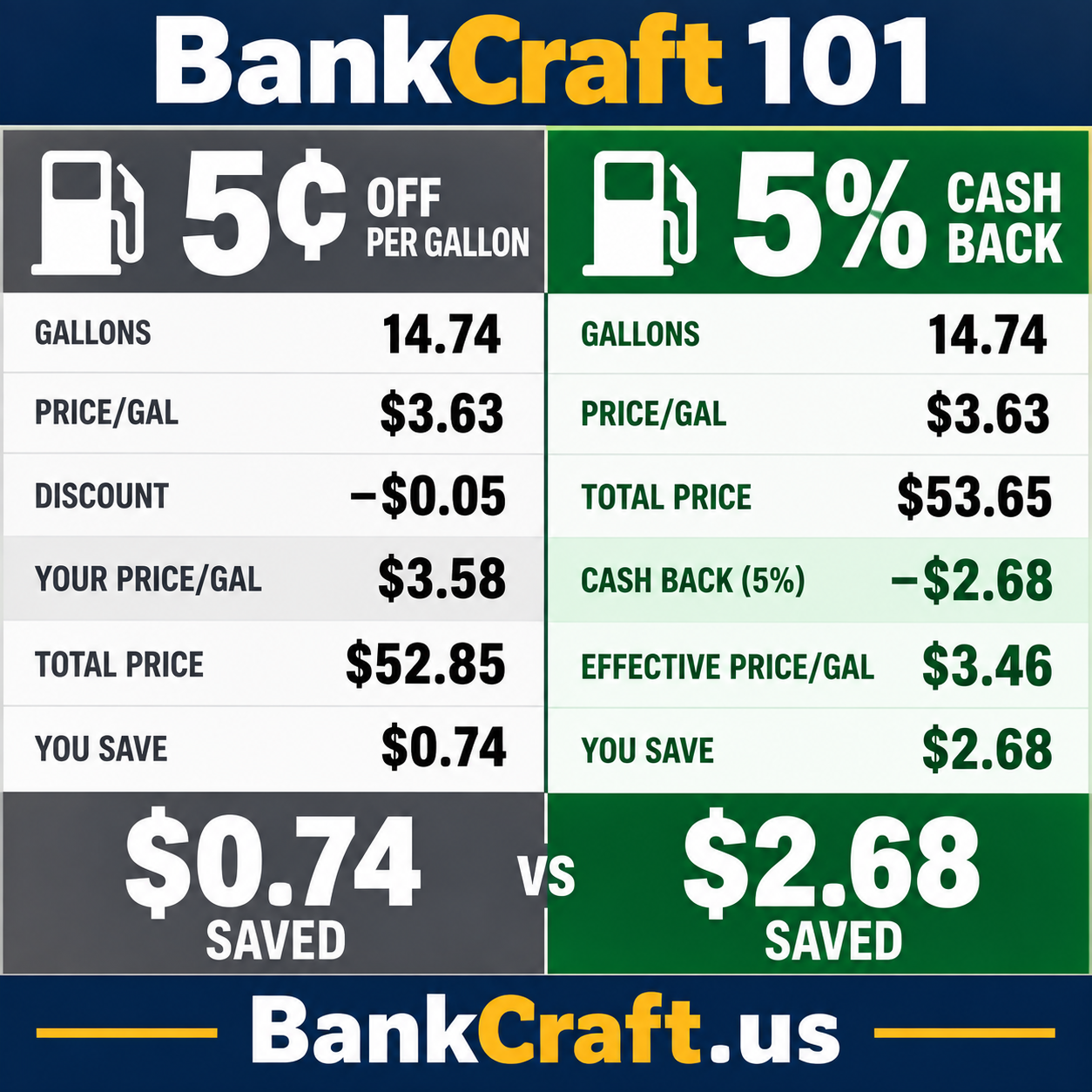
Do not compare the advertisements. Compare the math. Then assign the purchase to the card that does the job best.
The Nonnegotiable Rule: Pay It Off.
With a purchase grace period in effect, you can earn rewards and avoid purchase interest by paying the full statement balance by the due date.
That is where cash back works in your favor.
But there is one nonnegotiable rule: pay the full statement balance by the due date, not just the minimum payment.
If you do not pay it off completely, interest can wipe out the reward very quickly.
If you cannot afford to pay the full statement balance, try not to use the credit card at all.
There are times when life leaves you little choice and credit becomes necessary. But borrowing month after month can become extremely difficult to escape. Minimum payments can make the balance look manageable while interest keeps working against you.
Cash back should never be the reason you carry debt.
Use the card as the instrument. Collect the reward. Pay it off. Start the next month at zero.
See the cards described as performing these jobs in D.B. Nomad's wallet.
Behind the Curtain
The Cost of 5% When It Has Strings
Five percent cash back on every purchase can be completely real and still be a worse deal than a plain 2% card.
The percentage is only one part of the transaction.
The institution already did the math before it made the offer.
You should too.

Watch the whole table.
Three-card Monte works because your attention stays on the card the dealer wants you watching.
A financial offer can create the same problem if you stare at the giant reward percentage and never ask what had to happen somewhere else to make that percentage possible.
Where does your money have to sit? What does it earn while it sits there? What are you pledging? What kind of debt are you creating? What does the institution gain from the arrangement?
If you never ask those questions, you are trying to evaluate the deal while watching only one card.
They’re BANKING on you not looking.
Buyer beware. Look at the whole table.
Case Study: Bank X
When does 5% become less than 2%?
Bank X advertises 5% cash back on every purchase.
That sounds fantastic.
But to unlock 5% cash back on up to $25,000 of annual purchases, suppose Bank X requires you to maintain $25,000 in a qualifying checking account earning 0%.
The 5% is real.
But so is the $25,000 sitting there.
If that same $25,000 could earn 4.25% somewhere else, it could produce approximately:
Now compare the entire relationship, not just the number printed in the biggest font.
| Choice | Card Reward on $25,000 | Interest on $25,000 | Total Annual Value |
|---|---|---|---|
|
Bank X 5% Required money earns 0% |
$1,250.00 | $0.00 | $1,250.00 |
|
Plain 2% card Money earns 4.25% |
$500.00 | $1,062.50 | $1,562.50 |
|
Plain 1% card Money earns 4.25% |
$250.00 | $1,062.50 | $1,312.50 |
|
No-reward card Money earns 4.25% |
$0.00 | $1,062.50 | $1,062.50 |
Look at that again.
The 5% card produces $1,250.00.
A plain 2% card, while leaving the $25,000 earning 4.25%, produces $1,562.50.
Even a plain 1% card produces $1,312.50.
Five percent just lost to one percent.
The no-reward card does not quite beat the 5% card in this example, but look how close it gets.
The giant 5% headline creates only $187.50 more annual value than leaving the $25,000 earning 4.25% and receiving no card rewards at all.
And this assumes you actually spend the full $25,000 needed to collect the entire $1,250 reward.
If you spend only $10,000 on the 5% card, you receive $500 in cash back while the $25,000 could still have produced approximately $1,062.50 elsewhere.
Now the relationship is approximately $562.50 behind before comparing it with another rewards card.
This example uses $25,000 of qualifying money earning 0%, $25,000 of eligible annual card spending, and a 4.25% alternative yield. Different rates, limits, fees, spending levels, taxes, and qualification rules will change the result.
Another Curtain
3% cash back sounds great. What is underneath the card?
Now suppose another advertisement leads with 3% cash back on every purchase.
Keep reading.
The product is a home equity credit card.
The 3% may be completely real.
This one is not primarily a rewards math problem. It is a borrowing and collateral question.
The reward percentage is no longer the most important part of the decision.
BankCraft wants to know what kind of credit you are creating and what stands behind the debt.
- Is this ordinary unsecured credit, or is home equity involved?
- What APR applies?
- Are there fees, draw requirements, or other conditions?
- What happens if the balance is carried for months or years?
- Would you still choose this borrowing structure if the 3% reward disappeared?
BankCraft rule: Never let a reward make a borrowing decision for you.
Pay no attention to the man behind the curtain.
BankCraft walks behind the curtain.
We do not have to decide whether an advertisement is good or bad.
We do not have to tell you what to choose.
We do the math.
The percentage in the largest font is where you start reading, not where you stop.
The percentage needs a job description.
The 2%, 3%, and 5% figures above are examples of roles, not a promise that every card earns those rates. Before giving a card a job, find out which purchases qualify and what happens after any cap. A supermarket inside a larger store may not earn the same category reward as a standalone grocery store. The issuer’s terms and the merchant’s classification matter.
- Does the reward require activation, a particular wallet, a membership, or a linked account?
- Is there a spending cap, and what rate applies afterward?
- What is the cash redemption value? A point is not automatically a penny.
- Will a fee or merchant surcharge eat the extra reward?
- Can you manage another payment date without making the system harder to run?
Compare the extra dollars.
Suppose you already earn 2% and are considering a card that earns 3% on $500 of eligible monthly purchases. The improvement is one percentage point: $5 a month, or $60 a year. That is the benefit to compare with any extra cost or work, not the full $180 earned at 3%.
At the pump, the comparison above assumes the same purchase price and that both rewards apply as described. If the station charges more for credit, include that difference. If the nickel discount and card reward can legitimately be combined, compare that option too.
Make paying it off part of the system.
The statement balance is the amount billed when the cycle closes. The current balance may also include newer purchases that are not due yet. Full-statement-balance autopay can help, but verify its first payment and keep enough available money in the paying account.
Grace periods are not guaranteed. If you have been carrying a balance, ask the issuer how to restore the purchase grace period and whether residual interest remains. Cash advances and balance transfers may have different rules. Rewards do not turn borrowing costs into free money.
A $1,000 purchase at 2% produces $20 in rewards. Buying something you would otherwise skip still costs you about $980. Spend for your needs; choose the card afterward.
Give each card a chair.
Start with a dependable everyday card. Add a specialist only when its actual benefit earns the extra work. Check the posted reward on a real purchase, confirm the payment, and keep the assignment simple enough to use at the checkout counter.
The goal is a useful wallet, not a collection of applications.
BankCraft Protocol
Giving Every Card a Job
Start with the purchase, not the reward. Buy what you need. Use a dependable everyday card and add a specialist only when the extra dollars justify the work.
Compare the math. Check eligible categories, activation, caps, redemption value, fees, surcharges, required balances, linked accounts, and anything else you must give up to earn the advertised rate.
Look behind the curtain. Ask what had to move, sit, secure, or change for you to get the percentage. Compare the entire financial relationship, not just the reward printed in the largest font.
Watch the whole table. Do not let one bright percentage hold your attention while the cost of the relationship moves somewhere else.
Verify the result. Check the reward on a real purchase. Confirm the purchase grace period and payment setup, and keep enough money available to pay.
Pay the full statement balance by the due date. If you cannot pay it off, do not use the card for rewards. Give it a job. Keep the reward. Skip the interest.