Bank on My Terms

Presented by Digital Banking Nomad

Bank on My Terms

The Art of BankCraft™

Build Your Financial Symphony

Choose institutions for what they do best. Give each one a job. Test the connections. Build alternate routes. You are the conductor.

Last updated: September 1, 2026

A Discipline, Not A Product

The Art Of BankCraft

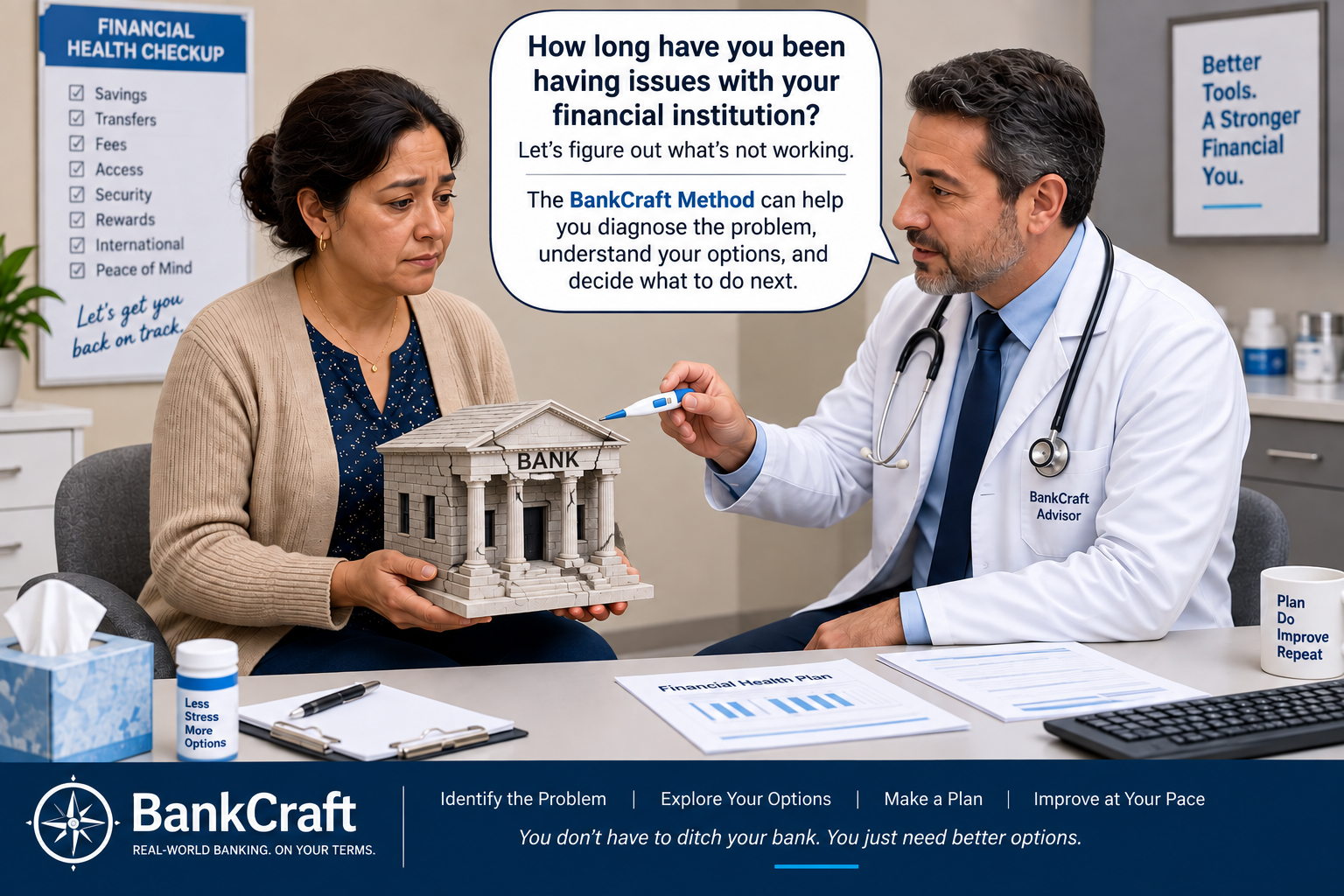
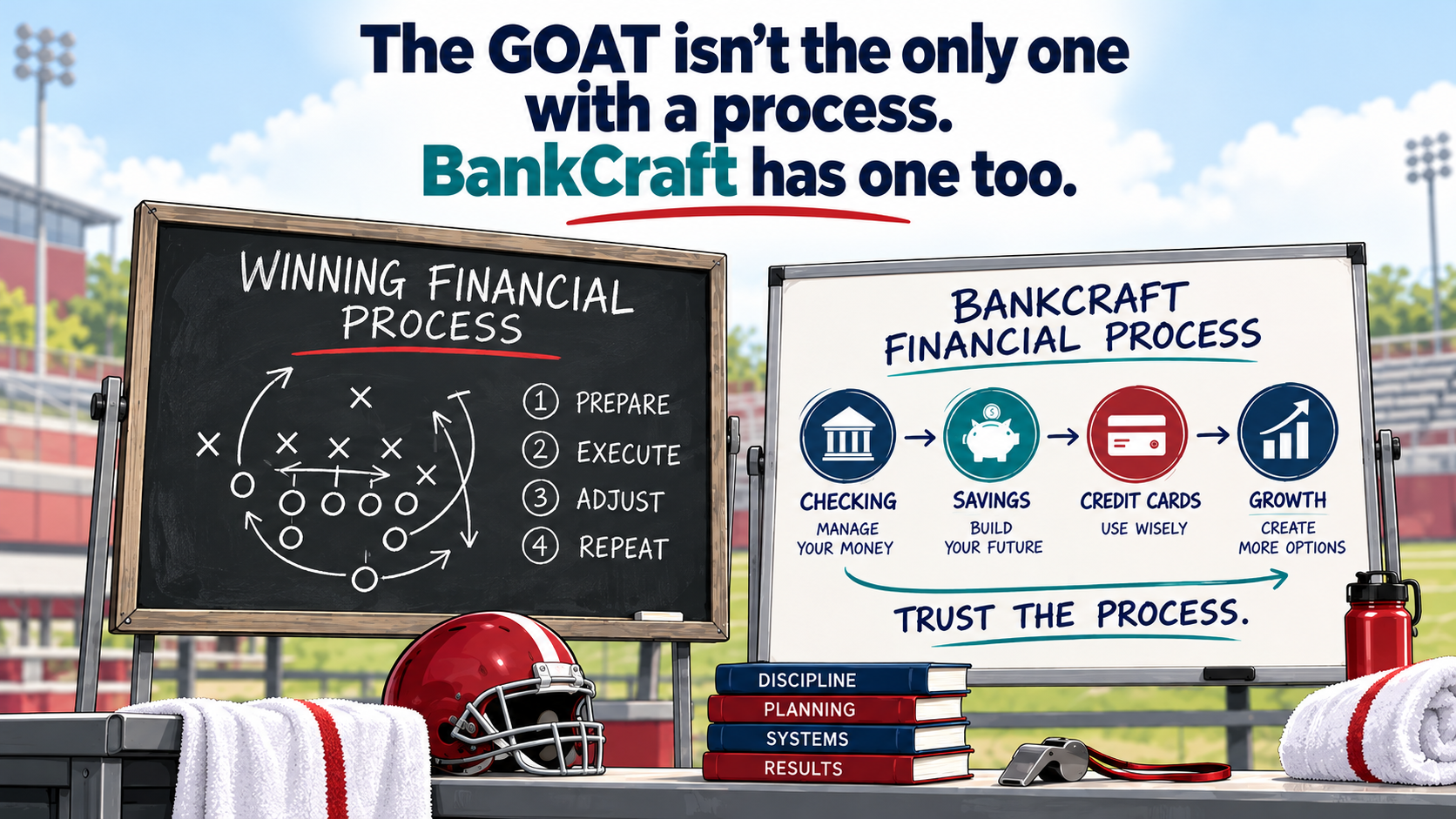
Banking is not a product you choose once and live with forever. It is a system you design, test, and improve. The Art Of BankCraft is the deliberate practice of assigning each institution a job, understanding how money can move between them, and building alternate routes before one bank's limits, holds, or failures leave you trapped.

Every institution has strengths, limits, and blind spots. The craft is using its strengths, routing around its weaknesses, and making the entire banking system work for you.

Your Banking Ecosystem — Made Visible

Build Your Financial Symphony

Your banking ecosystem is your Financial Symphony.

Stop expecting one institution to play every part. Give each bank or credit union the chair it earns and let it perform the job it does best.

The BankCraft Financial Symphony showing a banking ecosystem as a musical ensemble with different financial institutions performing different roles and the account holder as conductor

Anchor. Specialist. Active. Vault. Reserve. Benched. A ★ Bridge is a special capability that can connect parts of the Symphony that otherwise cannot reach one another.

You are the conductor. You decide who plays, who sits in reserve, who gets a solo—and when an institution needs to put its horn in the case and leave.

Don't let one institution turn your financial life into a one-trick pony when you can build a Symphony.

Like any strategic craft, it begins with knowing the terrain: which routes are open, where the chokepoints are, and what alternatives remain when the obvious path is blocked. This is not about collecting accounts for sport or chasing every shiny APY. It is about knowing your anchors, specialists, active players, vaults, reserves, bridges, transfer limits, and escape routes—and using them with purpose. That is The Art Of BankCraft.

For a simple address to this guide, use Bankcraft.us, Bankcraft.art, Bankcraft.net, TheArtOfBankcraft.com, or ArtOfBankcraft.com. Each address leads here.

Need a translation?

BankCraft has its own language, and banking has plenty of jargon of its own. Open the BankCraft Glossary → for plain-English definitions in alphabetical order.

BankCraft 101

Cash back is an instrument, not a perk.

BankCraft is not only about where money sits or how it moves. It is also about what happens every time you spend it. Give a small number of cards specific jobs, then route each purchase through the instrument that performs that job best.

2% — The Baseline A dependable general-purpose card can handle ordinary purchases whenever no specialist earns more.
3% — The Specialist A card can earn its place by paying more for a wallet, merchant, or spending category you use regularly.
5% — The Precision Tool Five-percent rewards are often category-specific, capped, rotating, membership-based, or tied to particular merchants. Read the rules.

Those percentages illustrate different jobs. The actual value depends on eligible purchases, caps, fees, and requirements. A card earns its chair by improving the purchases you already make.

The Gas Pump Test

Would you rather save 5¢ or 5%?

On a real 14.74-gallon, $53.65 fill-up, five cents off per gallon saved about 74¢. Five percent cash back returned $2.68—more than three and a half times as much. Even a 2% card returned about $1.07 and beat the advertised nickel.

BankCraft 101 comparison of five cents off per gallon with five percent cash back on a 14.74-gallon gas purchase
Real purchase: 14.74 gallons, $53.65 total, approximately $3.64 per gallon.

The comparison assumes the same purchase price and that the rewards qualify. A credit surcharge or a discount you can combine with rewards changes the calculation.

Do not compare the advertisements. Compare the math.

The Nonnegotiable Rule: Pay It Off.

With a purchase grace period in effect, pay the full statement balance by the due date to avoid purchase interest. Interest and fees can erase the reward. The minimum payment is not the payoff plan.

Give your credit cards a job

Take the full Gas Pump Test, compare the extra dollars, check the qualification rules, and build a wallet that earns its place.

Continue in the Classroom →

Money Movement

Can your money get in—and back out?

You found a promising institution. The APY looks good, the account is open, and the app is polished. Wonderful. Now find out whether your money can move the way you need it to.

Seeing an account is not the same as connecting it.

An app may display another bank’s balance without giving you a way to transfer money. The connector’s logo does not answer the practical question: what does this connection actually let me do?

ACH is the electronic network behind many bank transfers and bill payments. Once your outside account is verified, the side that receives your instruction matters.

PUSH → Send it

Start where the money is.

Sign in at Bank A and tell it to send $500 to Bank B.

PULL ← Retrieve it

Start where the money is going.

Sign in at Bank B and tell it to retrieve the same $500 from Bank A.

The money travels from A to B either way. But the available limits, timing, and holds may differ because you used a different institution’s transfer service. Both institutions’ rules still apply.

The route has conditions.

A generous per-transfer limit may sit beside a restrictive monthly limit. A deposit may appear in the account before it is available to spend. And a successful bank transfer does not prove that a utility or insurer can debit that account correctly.

Never trust an untested route. Learn the return trip before moving a buttload of money.

Learn how the money moves

Walk through linking, push versus pull, limits, holds, merchant withdrawals, and a practical transfer test.

Continue in the Classroom →

Core BankCraft Principle

Improvise. Adapt. Overcome.

Do not confuse a blocked route with a dead end.

An institution can be excellent at holding savings and awkward at moving them. Before dismissing the account, look at the system around it. Can another institution provide the connection it lacks?

Improvise = find another way when the obvious route does not work.
Adapt = change your banking setup to use that alternative.
Overcome = accomplish what you were trying to do anyway.

EleVault did not change. I changed the route.

In my August 2026 testing, I wanted EleVault to be the Vault in my Financial Symphony. Its own $2,500 transfer pathway was too restrictive for the job. But Abound could verify EleVault through microdeposits—small entries used to confirm control of an account—and provide another route.

That route used Abound’s transfer service and its limits, while remaining subject to the receiving account’s rules. EleVault kept the job it did well. Abound supplied the connection.

That first connection led to a better question: what other institutions can connect to EleVault from their side? One restrictive pathway became a network of useful bridges. Those were my tested results at the time; capabilities and limits can change.

Your bank is not your banking system.

A quiet account can be valuable even when very little money stays there. If it connects two parts of your Symphony, it has a real assignment. The value is the tested route—not the number of accounts you collect.

What other route can I build with the institutions I already control?

Build the bridge

Follow the full EleVault example, see how alternate connections work, and learn what to test before relying on a two-step transfer.

Continue in the Classroom →

Access Is Part of the Account

A great account still has to let you in.

An account may work beautifully at home and become difficult to reach when you travel. The website will not load. The app wants another identity check. The verification code goes to a phone number you cannot use where you are.

That is a banking feature worth evaluating before you need the money.

A VPN is not a guarantee against geo-blocking.

A VPN can change the network address a bank sees, but it does not override the bank’s access policies. A bank may block VPN connections, and an address that worked on one trip may fail on the next.

My testing from Honduras produced both outcomes: some institutions allowed normal access, while others required changes of VPN server or blocked the VPN connection itself. That experience does not predict every traveler’s result. It shows why “I can log in from home” is only part of the evaluation.

If you cannot reliably reach the account, its APY, transfer limits, and polished app do not matter.

Your highest-yield account does not have to be your everyday travel account. Give dependable access a chair in the Symphony, and keep a supported backup before you need it.

Make sure you can reach your money

Evaluate website and app access, prepare your verification methods, and plan what to do if a sign-in fails.

Continue in the Classroom →

Frequently Asked Questions

BankCraft FAQ

Clear answers to the questions people ask when they begin building a Banking Ecosystem.

What is BankCraft?

BankCraft is the practical skill of choosing financial institutions for their strengths, assigning each one a specific job, connecting them, and building dependable routes for moving and protecting your money. You are not bound to one institution. You build a system in which every institution must earn its place.

What is The Art Of BankCraft?

The Art Of BankCraft is the strategy behind the system. It means understanding regulations, ACH networks, verification methods, transfer limits, holds, fraud controls, and each institution's risk tolerance before moving your money. Learn the terrain. Know your routes. Prepare another route before you need it.

What is a Banking Ecosystem?

A Banking Ecosystem is a group of financial institutions working together under your direction. Think of it as a symphony: one institution may serve as your Anchor, another as your Vault, another as a Specialist, and another as a Bridge. You are the conductor. You decide who plays, what role each institution performs, and when an institution should be replaced.

How many financial institutions do I need?

There is no magic number, but one institution leaves you dependent on one set of rules, limits, and technology. Three well-chosen institutions are a practical starting point: a primary Anchor, a dependable Reserve, and an institution that provides a useful specialty or transfer route. Every account should have a reason to exist.

What is a Bridge institution?

A Bridge is a financial institution that creates a pathway between accounts that cannot connect directly. It may support microdeposit verification, provide stronger ACH capabilities, or connect institutions with incompatible linking systems. A Bridge may not offer the highest interest rate, but the route it provides can make the entire Banking Ecosystem work.

What is the difference between pushing and pulling money?

A push begins at the institution sending the money. A pull begins at the institution receiving it. The same two accounts may have different limits, holds, speeds, and verification requirements depending on which institution initiates the transfer. When one direction is restricted, the other direction may provide a better compliant route.

Are banks the enemy?

No. The banks are not the battlefield. The system is.

Every financial institution operates under its own policies, technology, regulatory responsibilities, fraud controls, and risk tolerance. BankCraft does not mean fighting banks, breaking their rules, or trying to defeat their safeguards. It means understanding the system, working within the rules, and choosing another legitimate route when one path does not meet your needs.

BankCraft Reference

Need a term? Start with the glossary.

BankCraft and banking terms, together in one practical reference. It is easier to scan, easier to update, and easier to link directly from lessons, reviews, and field reports.

BankCraft Glossary

APY, ACH, Bridge, Vault, Financial Symphony, microdeposits, holds, push, pull, settlement, transfer limits, VPNs, and more—all in plain English. Browse the glossary →

Put the Framework to Work

Let every institution earn its place.

The Classroom explains the mechanics. Field experience shows how institutions perform when the money starts moving.

Ready to build your Financial Symphony?

See how the institutions performed in the field, what chairs they earned, and which ones are still playing.

Explore Institution Reviews →
Bank on My Terms, presented by Digital Banking Nomad, provides independent educational information based on real-world experience. Services, connection methods, limits, holds, and provider relationships can change. Verify current terms and capabilities directly with the institution before moving money. This is not individualized financial advice.