
The Art of BankCraft™
Featured Classroom Case Study
Trust the Process!
Having money is not the same as having reliable access to that money.
It Started With a Failed Payment
The money was there. The payment failed anyway.
Imagine having more than enough money in your savings account to cover a credit card payment. You've made payments from that account before. Everything worked. You have no reason to expect a problem.
Then one day, the payment fails.
What?
The money is sitting right there! How can a payment fail when you've got more than enough to cover it?
This isn't hypothetical. It happened.
A credit card issuer changed the ACH payment account designation from savings to checking without my knowledge or authorization. Previous payments from that savings account had worked. Then a payment failed, despite sufficient available funds.
The account designation change was confirmed. What was never established was why the issuer made that change.
I won't name the institution here because the purpose isn't to single out a credit card company. It's to explain what the incident revealed.
One change in a payment instruction disrupted a transaction that had previously worked. That raised a much bigger question:
What other single points of failure were hiding in my financial system?
Look Beyond the Balance
Five places a single point of failure can hide.
A dependable financial system requires more than available money. It requires dependable ways to spend it, transfer it, protect it, and access it when something goes wrong.
Your bank becomes unavailable.
An account restriction, system outage, or unexpected institutional decision interrupts access to your money.
Your primary card stops working.
A fraud alert, compromised card, or technical problem interrupts your ability to make purchases.
An automatic withdrawal fails.
The money exists, but the route between the credit card issuer and the funding account doesn't work as expected.
The required account isn't supported.
An issuer may not accept your selected institution or account type for the payment arrangement you want.
You need cash but can't get it.
An ATM outage, hurricane, or failed payment network leaves electronic money inaccessible when physical cash is needed.
These aren't five unrelated problems. They're five places to apply the BankCraft Protocols.
Build the system. Test the connections. Verify the results. Keep alternatives available.
Eliminate Concentration Risk
Why put everything in one financial institution?
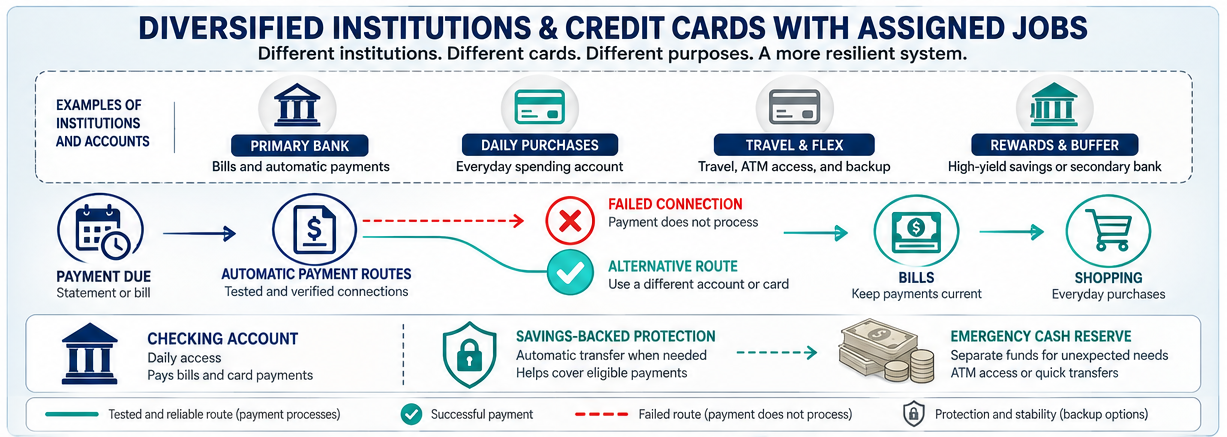
Suppose one bank controls nearly every aspect of your financial life. Your income arrives there, your savings live there, your credit cards are paid from there, and your debit card depends on it.
Everything works beautifully—until it doesn't.
One restriction, outage, or unexpected decision could affect your entire financial operation. That's a single point of failure.
BankCraft encourages you to examine whether distributing responsibilities among different institutions could make your system more reliable.
One institution might be your primary payment hub. Another might offer competitive savings. A third might provide better ATM access or an independent backup.
Don't open accounts just to have more accounts. Every institution should have a job.
Give Every Card a Purpose
I'm Not Collecting Credit Cards. I'm Giving Them Jobs.
Why would anybody want several credit cards? Isn't one enough?
That's a fair question.
I'm not interested in how many cards I have. I'm interested in what each card can do for me.
After diversifying my money across several financial institutions, I started wondering why I was still concentrating practically all my spending on one credit card.
I wasn't carrying credit card debt from month to month. I paid my statement balances in full. But I was creating one enormous monthly payment that had to come from somewhere.
Why not distribute the spending among cards selected for different jobs?
Find a Dedicated Gas Card
Suppose you find a card earning a consistent 5% cash back on eligible gasoline purchases. Assign it one job: buying gas.
Ideally, avoid rotating categories that require quarterly activations or constant attention.
Let Retailers Reward You
If you regularly shop at Amazon or another retailer, a store-associated credit card may offer enhanced rewards on eligible purchases.
Use that card where its benefit applies.
Earn More Where You Tap
Some cards offer enhanced rewards, perhaps 3%, through eligible mobile-wallet or contactless purchases.
Check the terms. Simply tapping any card doesn't automatically earn extra rewards.
The Dependable 2% Workhorse
A general-purpose card earning 2% cash back on eligible purchases can handle everything that doesn't qualify for a better reward.
Straightforward. Predictable. One specific job.
Each card now has a purpose. The statements can also help identify spending by category. And if one card becomes unavailable, you have another way to pay.
Instead of one enormous credit card payment, you've distributed your payment obligations. But you haven't reduced the amount spent.
And don't add another card until you know how you're going to pay it.
What If You Can't Qualify for Several Cards?
Not everybody is in a position to qualify for multiple credit cards. Your credit history, score, income, and other circumstances may limit your options.
Even if you qualify, additional cards can mean hard credit inquiries, annual fees, changes to the average age of your accounts, and more statements to manage.
And if you're already struggling with debt, opening more cards may make things worse.
Work with the financial tools available to you today. Learn about the tools that may become available tomorrow.
As your circumstances and creditworthiness improve, additional strategies may become practical. When that happens, you'll already understand how to use them.
Not every BankCraft Protocol fits everyone today. But learning how the tools work prepares you to recognize future opportunities.
Follow the Money
You've diversified the cards. Now who's paying them?
Here's where the BankCraft Protocols begin working together.
You may have four credit cards with separate jobs and money distributed among several institutions. But every card eventually needs to be paid. Which account will fund which card?
Perhaps a larger direct deposit goes to one institution while a smaller deposit supports another payment bucket. One account handles larger recurring obligations; another handles smaller category-specific payments.
Available reserves can replenish those accounts when spending exceeds expectations. But now another question arises:
What if the credit card issuer can't automatically pull the payment from the institution holding your money?
The institution might not appear in the issuer's linking system. The issuer might not accept your particular savings product. Or the connection might not work the way you expected.
You could manually transfer money or send a check. But now you're back to remembering and supervising the payment.
That's not the automation we're trying to build.
What If the Bank Isn't Listed?
Don't give up immediately. A missing institution in an instant-linking directory doesn't always mean automatic payments are impossible.
Some card issuers allow manual entry of routing and account numbers, sometimes followed by verification deposits or another confirmation method.
You may also have an alternative route through the bank's electronic bill-pay system. But confirm whether it supports recurring payments and whether it can automatically adjust to the actual statement balance.
Let the System Work
I don't want another job managing my money.
I want my income deposited automatically, my routine bills paid automatically, and my credit card statement balances paid automatically and in full.
I want to build a dependable system, not spend every month managing one.
Autopay Pull
The credit card issuer initiates the payment from your designated funding account. Full-statement autopay can adjust the payment to the statement balance each cycle.
Automatic Bill-Pay Push
Your bank sends the payment electronically or sometimes through a scheduled check. A fixed recurring amount may not match a changing credit card statement balance.
What If You're Living Paycheck to Paycheck?
I've lived that way, too. When money is tight, every payment date matters. An automatic withdrawal arriving before a deposit can create a serious problem.
But selective automation may still help protect essential obligations. Rent, car payments, and insurance are possibilities when the timing and funds are dependable.
Automate as much as your cash flow can safely and reliably support.
Automation reduces work. It doesn't eliminate verification.
Protect the Payment Hub
Free Overdraft Protection: Which Savings Account?
A checking account can become an effective automated payment hub, even if you previously had little need for one.
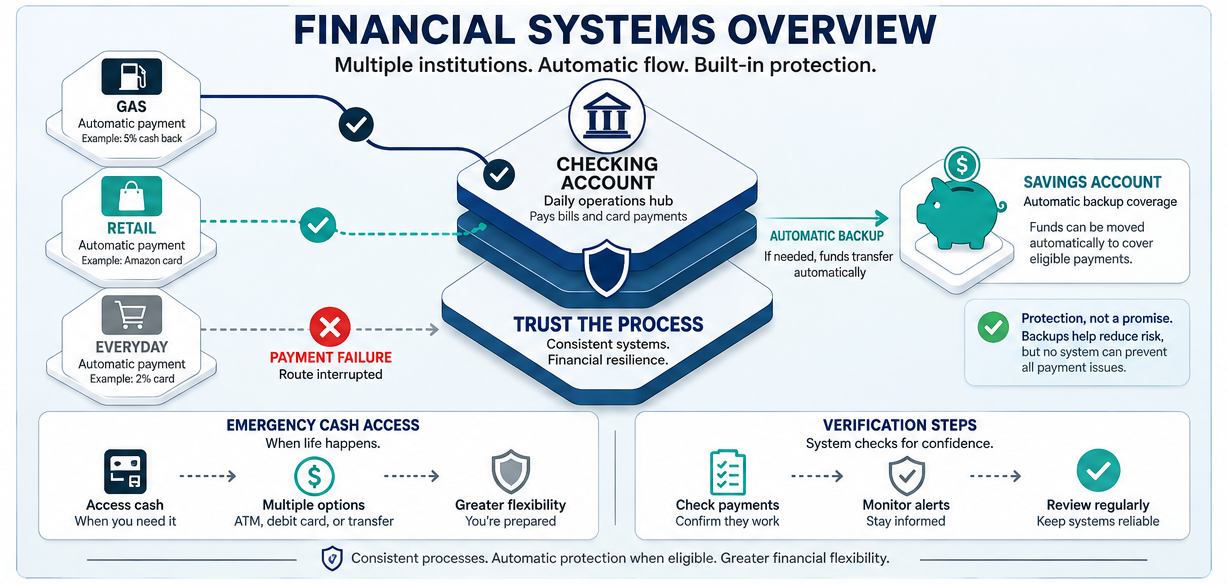
Checking handles the payments. Savings holds the reserve. Automatic savings-funded overdraft protection can connect them when an eligible checking transaction exceeds the available balance.
Overdraft Protection or Sweep?
Some financial institutions call the arrangement overdraft protection. Axos, for example, uses the term overdraft sweep.
In the specific arrangement we're discussing, both describe automatic transfers from designated savings into checking to cover eligible shortfalls.
But overdraft protection is also a broader term that can include credit-based or other services. Don't assume every product works the same way.
A Simple Example
Your checking account has $10. A $400 eligible payment arrives. Your linked savings has sufficient available funds.
Depending on the institution's rules, the system could automatically transfer the required $390 into checking, allowing the payment to be covered.
No manual transfer. No remembering to move money first.
But It Must Be FREE.
Some institutions advertise overdraft protection but charge enrollment, monthly, or per-use fees. That's not the arrangement I'm looking for.
If I have sufficient money sitting in savings, I don't want to pay a fee just to have my own money transferred into checking.
Free means free.
And Not Just Any Savings Account Will Do.
Here's the catch many consumers never think to ask about.
A financial institution may have a basic membership savings account paying very little interest and a separate high-yield savings product paying considerably more.
But its automatic overdraft protection might only draw from the basic savings account.
You could have plenty of money in the high-yield account and still have a payment fail because that specific savings product isn't eligible for the automatic transfer.
Verify that it is free, covers the transactions you need, and draws automatically from the exact savings product holding your money.
This is where reading a list of advertised banking features isn't enough. You have to understand how those features actually operate together.
Prepare for the Unexpected
What Happens When the Card Terminal Stops Working?
Imagine a hurricane approaching. You've prepared your home and have money available in several financial institutions. Then the power goes out.
Card terminals stop communicating. Businesses begin accepting cash only. Suddenly the question isn't how much money you have—it's how to get your hands on it.
You may rarely use an ATM. That doesn't mean you shouldn't maintain an active ATM or debit card.
Consider maintaining cash access through more than one institution and keeping a reasonable physical emergency reserve in a secure location.
Before a foreseeable emergency, verify your cards, understand withdrawal limits, and obtain needed cash while ATMs and branches are operating.
Remember that ATMs can also lose power, connectivity, or access to physical cash. Two ATM cards aren't fully independent if both depend on the same unavailable network.
It's having independent, tested alternatives when one route fails.
Before Something Goes Wrong
One Successful Payment Doesn't Prove the System.
Remember the failed credit card payment that started this discussion? Earlier payments had worked. The next one didn't.
That's why one successful manual payment doesn't prove that the next recurring autopay will work correctly.
Before relying on a new payment arrangement, perform a complete preflight check.
- Map the obligations. Identify each credit card, statement date, due date, and designated funding account.
- Map the income. Confirm that each payment bucket receives sufficient deposits or reserve funding before withdrawals occur.
- Confirm the connections. Verify routing numbers, account numbers, checking or savings designation, and issuer acceptance.
- Test the route, then the automation. Make a small manual payment if supported. Then monitor the first actual scheduled autopay through final posting. A manual payment is not proof of autopay.
- Verify protection. Confirm that savings-funded overdraft coverage is free, covers the relevant transaction types, and works with the exact savings product you use.
- Maintain a backup. Identify another accepted payment route or available funding account. Test it before relying on it.
- Monitor exceptions. Enable failed-payment, low-balance, and unusual-transaction alerts. Check payment confirmations and statements.
- Write the failure plan. Know how you'll respond if autopay fails. Review the payment-failure playbook before an emergency.
Don't discover the weakness during the emergency.
When Something Breaks Anyway
Your Autopay Failed. Now What?
No amount of preparation guarantees that every transaction will work perfectly. The objective is to recognize a failure, contain the damage, and restore normal operations quickly.
A rejected payment may result in fees, interest charges, or other consequences. Credit reporting consequences depend on how long an obligation remains unpaid and the circumstances involved.
The BankCraft Payment-Failure Playbook
- Check the actual status. Determine whether the original payment is pending, rejected, returned, or scheduled for another attempt.
- Check the deadline. Confirm the due date, current amount due, and whether a replacement payment can still be made on time.
- Use a tested alternative. If necessary, arrange payment through another accepted account. First confirm that the original payment won't also complete.
- Contact the issuer. Explain what happened, verify the payment instructions, ask about possible fee relief, and document the conversation.
- Verify final settlement. A confirmation number isn't the same as a posted payment. Follow the transaction until complete.
- Correct the weakness. Identify what failed, update the payment arrangement, and preserve a tested alternative for next time.
This is the difference between a controlled response and making the original problem worse.
Never Stop Reading the Field
The Playing Field Never Stops Moving.
You can design an excellent financial system, put the bills on autopay, test the connections, and give every account a job. That doesn't mean the work is finished. Banking is fluid. Institutions change policies, rates rise and fall, payment routes get blocked, and new opportunities open up.
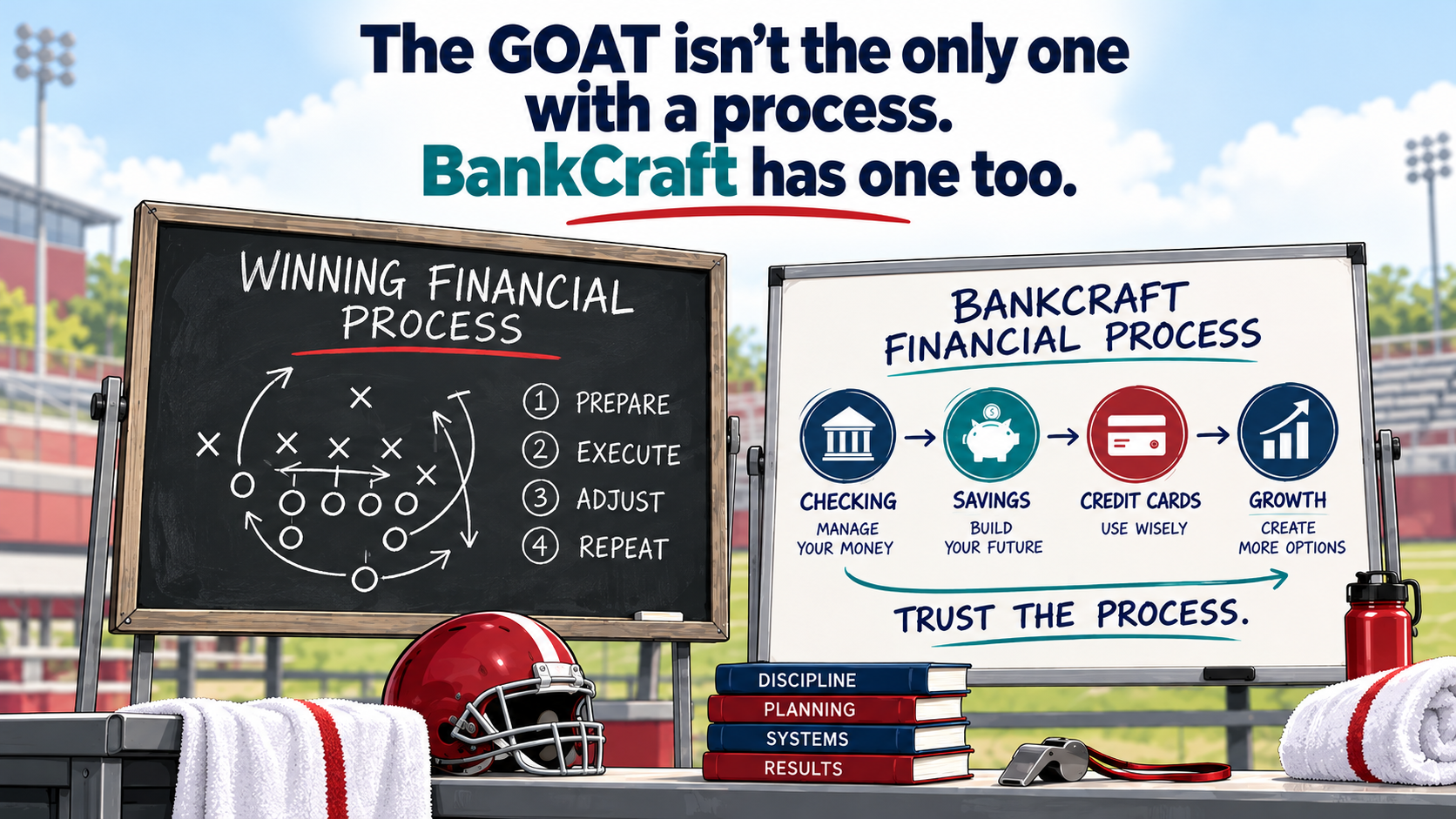
Think of a football game. You prepare the plays and establish your formation, but the defense doesn't stand still. An opening appears on one side while another route closes. You don't abandon the entire playbook. You read the field and adjust.
BankCraft works the same way. Build a solid foundation with dependable automation, free protection where available, tested backup routes, and accessible reserves. Then stay alert to meaningful changes. When a feature stops doing its job—or a better option emerges—reevaluate the assignment.
The protocols provide the foundation. Their application evolves as the playing field changes.
This isn't an invitation to tinker endlessly or chase every fraction of a percent. The goal is to automate the ordinary, monitor the exceptions, and respond when the facts justify a change. Your financial system should make life easier, not become another full-time job.
BankCraft is not a one-and-done exercise. You're not trusting a frozen arrangement to work forever. You're trusting a repeatable process of testing, learning, adjusting, and improving.
The Bigger Picture
Improvise. Adapt. Overcome.
One failed payment led to a question. That question exposed additional weaknesses and opportunities throughout the financial system.
Why depend on one bank? Why concentrate spending on one card? Why manually manage payments that could be automated? Why accept overdraft fees when an appropriate free alternative may be available?
And why build an electronic banking system without preparing for the day when electronic access isn't available?
BankCraft isn't about making everyone use the same accounts or financial products. It's about evaluating the available tools, assigning them meaningful jobs, and connecting them into a system suited to your circumstances.
As your circumstances change, the system can change with you.
Build the system. Test the connections. Eliminate unnecessary dependencies.
TRUST THE PROCESS!
I BANK ON MY TERMS!
Frequently Asked Questions
Trust the Process FAQ
Does having multiple credit cards mean carrying debt?
No. You can distribute spending across multiple cards while paying every statement balance in full. The objective is to assign jobs and maintain alternatives, not accumulate debt.
What if I can't qualify for several credit cards?
Start with the tools available today. Multiple cards aren't required to practice BankCraft. Understanding the strategy prepares you for possible future options.
If my bank isn't listed, is autopay impossible?
Not necessarily. Some issuers allow manual routing and account number entry or alternative verification methods. Confirm account eligibility and test the actual recurring payment arrangement.
Are overdraft protection and overdraft sweep the same thing?
An automatic savings-backed overdraft sweep is one form of overdraft protection. Institutions may use different names for the same basic mechanism. Other overdraft products can work differently and involve fees.
Does free overdraft protection work with every savings account?
No. An institution may restrict automatic coverage to certain savings products. Verify that your specific savings account qualifies before relying on the service.
Does one successful payment prove autopay works?
No. A manual payment and recurring autopay may use different processing arrangements. Verify the scheduled automatic payment itself and continue monitoring future cycles.
Should I automate every bill?
Automate only where your income timing, available balances, and reserves can reliably support withdrawals. Continue monitoring exceptions and payment confirmations.
BankCraft Protocol: Build a System, Not a Single Dependency
Distribute: Assign specific jobs to financial institutions and credit cards. Avoid concentrating every essential function in one place.
Connect: Confirm that every obligation has an accepted payment route and that the correct account type is designated.
Automate: Use reliable automatic payment arrangements when your cash flow safely supports them.
Protect: Maintain suitable reserves and verify free automatic overdraft protection from the exact savings product you use.
Prepare: Keep independent alternatives, emergency cash access, and a written payment-failure plan.
Verify: Test the actual automation, monitor exceptions, and revise the system when circumstances change.
Trust the Process! Not because institutions cannot fail, but because you've prepared alternatives for when they do.
Bank on My Terms provides independent educational information based on real-world experience. Financial institution features, payment processing, account eligibility, cash-back rewards, fees, overdraft services, and transfer rules vary and may change. Verify current terms directly with the relevant institution before relying on a feature or payment arrangement. This article is educational and is not individualized financial advice. Last reviewed: October 12, 2026.