
The Art of BankCraft™
BankCraft Classroom
Can Your Money Get In—and Back Out?
Link accounts, understand push and pull, and test the whole trip.
You got inside. Now test the doors.
You found a promising institution, opened an account, and looked around. Now comes the question that the advertised rate cannot answer: can your money get in—and back out—on terms that work for you?
ACH stands for Automated Clearing House. It is a network used for electronic transfers such as direct deposit and many bill payments. Here we are testing transfers between accounts you control. A wire, debit-card transfer, or instant-payment service is a different route with its own rules.
The First Rule
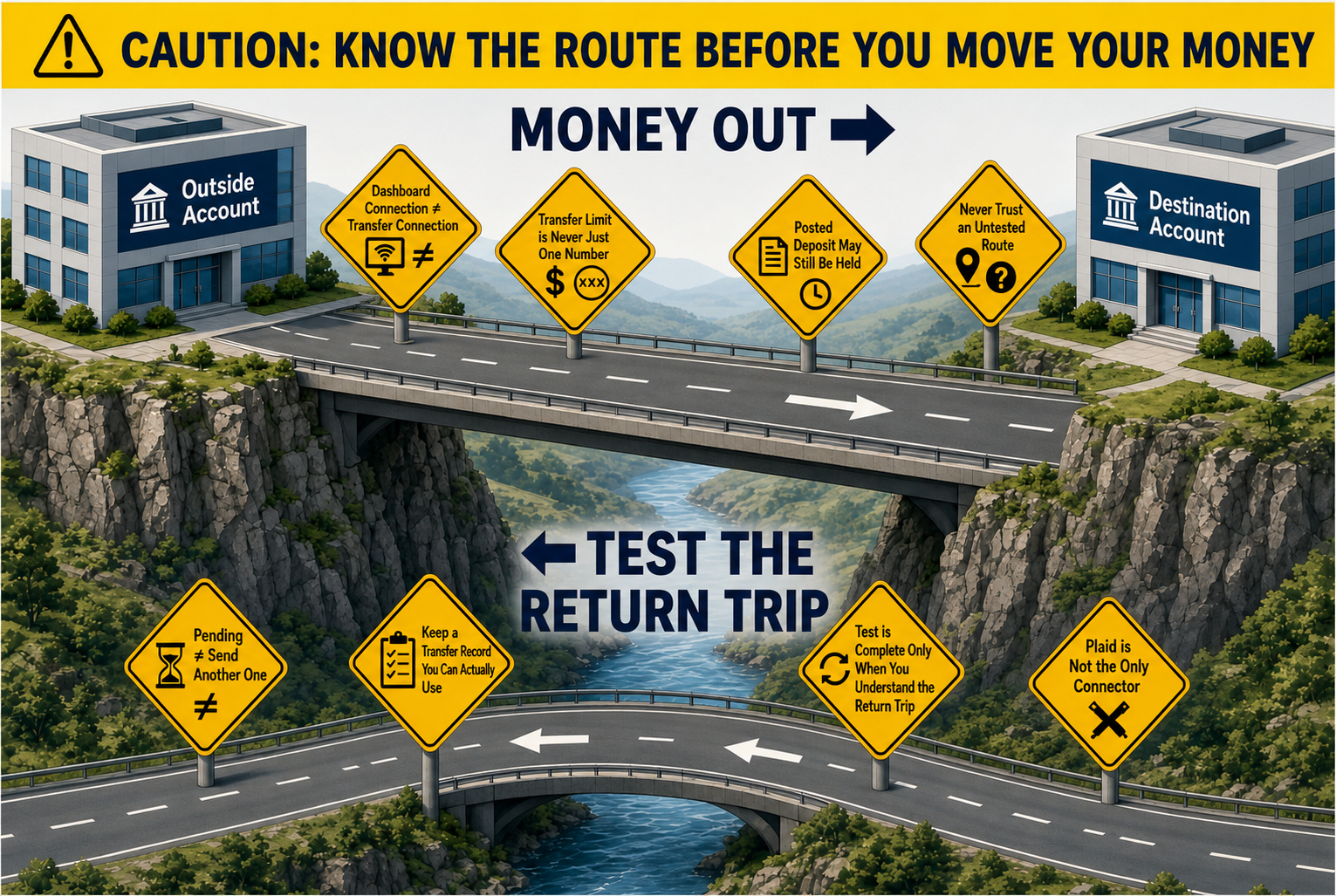
Do not mistake a dashboard connection for a transfer connection.
An app may show the balance and transactions from another institution without giving you any way to send money there. Account aggregation, account verification, and money movement are related—but they are not the same job.
If you can see the account but cannot push to it, pull from it, or let a merchant debit it, you have information—not connectivity.
Connection Methods
How an outside account gets linked.
OAuth or API connection
You are handed to your financial institution, sign in there, approve specific access, and return. The third-party app receives permissioned data rather than simply pretending to be you.
Credential-based linking
You enter online-banking credentials into a connection flow. The provider handles authentication and may need renewed credentials or multifactor approval when the connection breaks.
Routing number, account number, and microdeposits
You enter the account information manually. One or two small ACH entries arrive, and you confirm the amounts or verification information to prove control of the account.
Link from the other institution
If Bank A cannot add Bank B, Bank B may still be able to add Bank A. Which side initiates the transfer can completely change the available limit, hold, and success rate.
Manual linking is sometimes buried. A page may first show only a list of institutions, then reveal “Add manually” or “Don’t see your institution?” after you select or search. Do not assume the option is absent until you have looked through the complete flow.
Manual microdeposit verification is one of the strongest connection methods to find. When an institution lets you enter the routing and account numbers and verify ownership through microdeposits, you are not limited to the institutions that happen to appear in an aggregator's search.
Plaid gives you the roads it knows about. Microdeposits let you enter the address yourself.
Money Movement
Push and pull are two different trips.
The ACH network supports both credits and debits. In practical Bankcraft language, the difference is who receives your instruction.
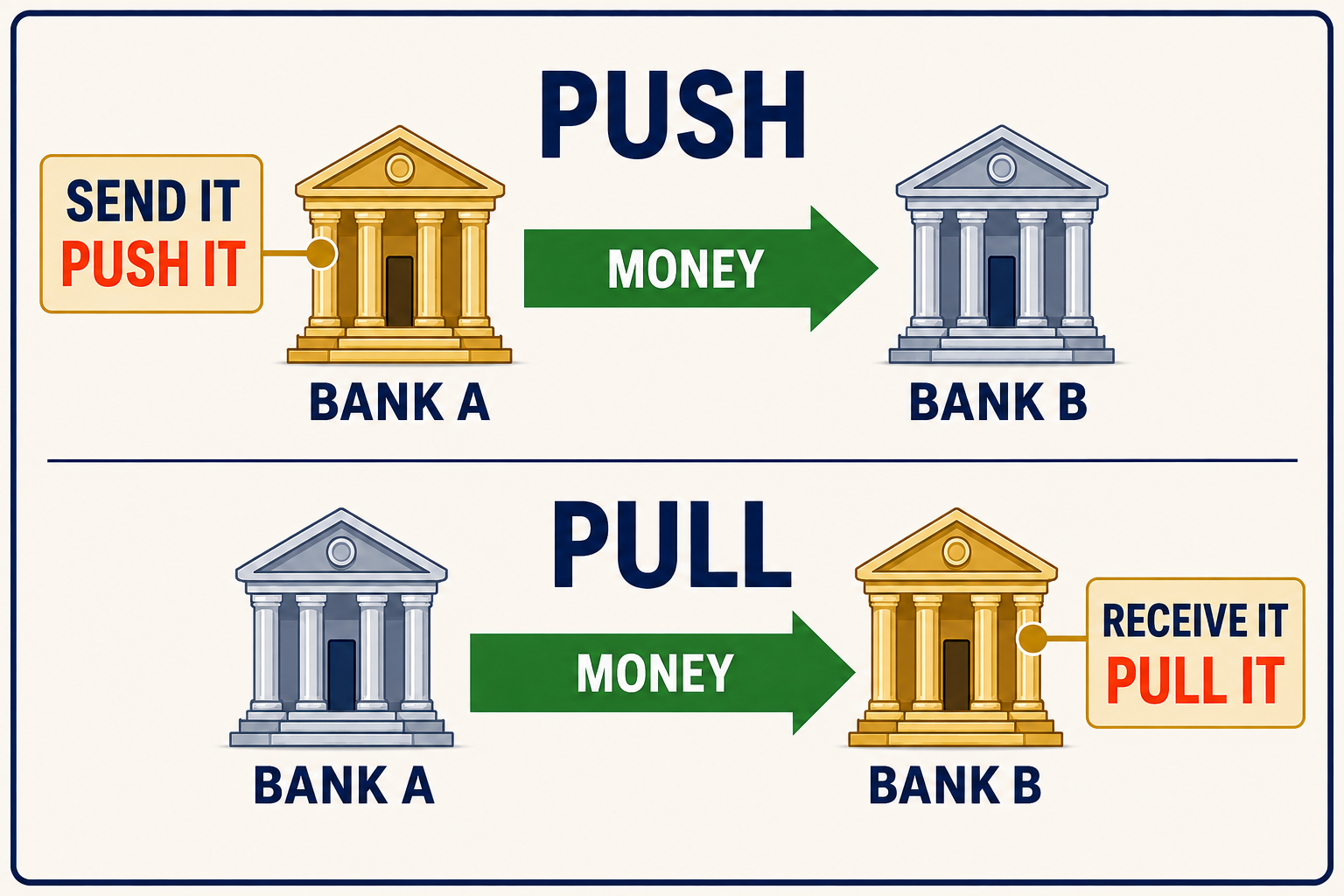
PUSH → Send it
Start where the money is.
You tell the institution holding the funds to send them to the receiving account. The sending institution’s push limit controls the trip.
PULL ← Retrieve it
Start where the money is going.
You tell the receiving institution to retrieve funds from the outside account. The receiving institution’s pull limit and hold policy control the trip.
As a hypothetical example, the same two accounts may support a $2,500 push in one direction and a $25,000 pull initiated from the other side. Where supported, test both directions with a small amount.
Same money. Same destination. Different instructions.
Suppose you want to move $500 from Bank A to Bank B. The money travels from A to B in both cases. The difference is where you give the instruction.
| Method | Where you sign in | Instruction |
|---|---|---|
| Push | Bank A, where the money is | Send $500 to my Bank B account. |
| Pull | Bank B, where the money is going | Retrieve $500 from my Bank A account. |
Write it out before confirming: From Bank A → To Bank B → $500 → Initiated at Bank A or Bank B. An account nickname should identify the institution and account clearly. It should not require you to decode a mystery later.
The initiating institution controls its transfer service and origination limits. The other institution can still reject an entry, restrict the account, or impose its own applicable rules. A larger limit on one side is not a guarantee that the transfer will succeed.
Read the Fine Print
A transfer limit is never just one number.
When an institution says “$5,000 limit,” the next question is: $5,000 per what—and for which direction?
- Per transaction: the most allowed in one transfer.
- Per day: sometimes measured by initiation date and sometimes by posting date.
- Per calendar month: commonly resets on the first day of the month.
- Per rolling 30 days: looks backward from today or from transaction posting dates.
- Transaction count: the dollar limit may be generous while the number of transfers is tiny.
- Push versus pull: each direction may have a completely different ceiling.
- New-account limits: the institution may temporarily reduce access or place longer holds.
Arrival Is Not Availability
A posted deposit may still be held.
A deposit can appear in the account, begin earning interest, and still be unavailable for withdrawal. Do not count held funds as immediately available emergency money. Keep enough accessible funds elsewhere for obligations that cannot wait.
Track the current balance, available balance, hold expiration, and the time required to move the money back out. A one-week hold going in plus several business days coming out can turn a savings account into a modified short-term CD.
ACH Has a Clock
ACH is not instantaneous.
An ACH transfer is not a bank wire. Money does not necessarily leave one account and become immediately available in another.
ACH transfers move through a process. The institution may have a cutoff time. Weekends and holidays can matter. A transfer may show as pending, then posted, and still not be available to move again. A pull may also be held longer than a push.
When money has to travel through more than one institution, those delays stack.
That is not one trip. It is two ACH trips, and the second trip may not be able to begin just because the first one appears on the screen.
Two ACH transfers mean two clocks.
Follow the ACH process all the way through: initiated, processing, posted, available. Do not assume that seeing the money means the trip is finished.
The Human Failure Point
The biggest ACH failure point may be the originator.
The ACH system can work exactly as designed and still move the money in the wrong direction because the person entering the instruction got the route backward.
That happens more often than people think. I have been told by financial-institution staff that customers reverse ACH directions all the time. I have personally done it more than once while managing multiple institutions and several transfers at the same time.
When you have six, seven, or eight transfers in motion, you have a lot of balls in the air. Similar account names, incoming and outgoing transfers, and poor transaction descriptions can make an obvious route surprisingly easy to reverse.
Write the route. Read the route. Say the route. Then send the money.
When a documented route requires more than one institution or several transfers within published limits, learn how to explain the difference between legitimate transfer planning and illegal evasion in The Elephant in the Room: Routing or Structuring?
Write down the trip before you press Send.
Before confirming an ACH, write down exactly what you intend to do:
TO: Abound
AMOUNT: $4,500
INITIATED AT: ValorFI
METHOD: ACH push
Then look at the confirmation screen and say it out loud:
“I am sending $4,500 FROM ValorFI TO Abound.”
Compare what you just said with what is actually on the screen before you submit it.
Label the transfer while you still know what it is.
If the institution gives you a memo, nickname, or note field, use it. Some institutions give you only about 10 characters, so keep it short and consistent.
Always.bank → Navy Federal
The exact abbreviation matters less than consistency. The note should answer two questions as clearly as the space allows: Who is sending it? Where is it going?
Do not depend on the bank to explain it later.
Some institutions provide excellent ACH records. They show the other institution, partial account numbers, direction, date, and enough detail that there is little ambiguity.
Others show almost nothing useful. The institution may have detailed information on the back end while the customer-facing website or statement shows a generic ACH description that tells you very little.
If two similar transfers leave the same account, you may have no practical way to tell which one went where unless you kept your own record. That is when you start wishing for the psychic hotline.
For every important ACH movement, record:
- Date.
- Exact time initiated.
- Source institution.
- Destination institution.
- Amount.
- Push or pull.
- Where the instruction was initiated.
- Memo or nickname used.
- Confirmation number.
- ACH trace number, if available.
If two similar transfers are moving at the same time, the exact initiation time may be the detail that lets you match your notes to what support can see internally.
Record the confirmation before you start the next transfer.
Merchant Compatibility
A bank transfer test is not a bill-payment test.
An external transfer proves that two institutions can exchange an ACH entry. It does not prove that GEICO, a utility, an insurer, or another merchant will accept the routing number, recognize the account number, debit a savings account, or send the debit to the correct share.
Credit unions create additional possibilities: a long member number, a shortened account number, a suffix, or a share number may direct the merchant to a different savings account than the one you intended. Test before trusting an important autopay.
The Field Test
Never trust an untested route.
Testing and documenting each route is how The Art Of BankCraft becomes a working system instead of a theory.
- Link the account and document which method was used.
- Run a small transfer in each direction.
- Record the push limit, pull limit, monthly limit, and transaction-count limit.
- Check how the destination is identified in transaction history.
- Measure when the transfer posts and when the money becomes available.
- Test a merchant withdrawal separately if the account will pay bills.
- Confirm that support can explain the transaction and provide a trace number when necessary.
- Keep another working route before moving a buttload of money.
Keep a transfer record you can actually use.
| Record | Example or question |
|---|---|
| Source and destination | Bank A checking → Bank B savings |
| Initiated at | Bank A; push |
| Amount and date | $25 test; date submitted |
| Status | Scheduled, processing, posted, available, or returned? |
| Timing | When did it leave A? When was it usable at B? |
| Limits and holds | Per-transfer, daily, monthly, count, and new-account restrictions |
| Reference | Confirmation number and, if needed, ACH trace number |
Keep sensitive account details out of public notes or screenshots. For your own record, a clear nickname and last four digits are usually easier to work with than a full account number.
Pending does not mean “send another one.”
Before retrying a delayed transfer, check its status at both institutions. A cancellation request is not proof of cancellation. Repeating the instruction can create two real transfers and drain the source account.
Leave enough available funds at the source until the transfer has been resolved. For an unclear or returned transfer, contact the initiating institution with the date, amount, source, destination, and confirmation number. Do not guess which entry is safe to replace.
A successful small test establishes a working route at that time. It does not guarantee a larger transfer will receive the same timing or avoid review.
Reviews and Risk Controls
Legitimate ACH activity can still trigger questions.
A transfer can be completely legitimate and still attract fraud or risk controls, especially when a large amount moves, several transfers occur close together, or money arrives and then moves onward quickly.
If an institution asks about the activity, explain it accurately. Do not retry, restructure, or split transactions for the purpose of avoiding review or monitoring. If the institution tells you a particular use is not permitted, respect the restriction and use another legitimate route.
A successful small test proves that a route worked at that time. It does not guarantee that a much larger transfer, a rapid series of transfers, or repeated pass-through activity will receive the same treatment.
The test is complete when you understand the return trip.
Funding the account is only half the evaluation. Learn how to retrieve your money, how long it stays unavailable, and whether the route works for the job you need. Keep important bills and direct deposit on dependable arrangements until the new account earns that responsibility.
Nacha explains how ACH credits and debits work. Its ACH payments fact sheet describes network processing; your bank’s customer-facing delivery estimate may also include its own processing and holds.
The Names You May Encounter
Plaid is not the only connector.
These are not different versions of Plaid. They are separate companies and networks that financial institutions and fintechs use to connect, verify, or retrieve information from outside accounts. You may see the provider’s name, its logo, a branded connection window—or no obvious identification at all.
Plaid
Plaid Link handles the account-linking experience, including institution search, credentials or OAuth handoff, multifactor authentication, errors, and account selection.
MX
MX provides account aggregation, ownership identification, balance checks, instant account verification, and microdeposit verification. The exact capability depends on what the institution purchased.
Mastercard Open Finance
Often still encountered through the Finicity name, Mastercard’s open-finance tools support permissioned data access, account verification, analytics, and some account-to-account payment uses.
Envestnet Yodlee
Yodlee’s account-aggregation and FastLink tools connect financial accounts and retrieve account and transaction information for financial applications.
Akoya
Akoya is an API-connected data-access network focused on permissioned financial-data sharing and giving consumers visibility and control over connected applications.
The Institution’s Own System
A bank may use its own digital-banking platform, a processor integration, or a mixture of services. The logo you see does not tell you every system operating behind the page.
The Bankcraft question is not “Which logo did I see?” It is “What does this connection actually let me do?”
Connector references
Provider features depend on the service your institution enables. These links help identify the systems; they do not promise that your bank offers every feature.
BankCraft Protocol
Testing the Whole Trip
Seeing an account is not proof you can move money. Verify the connection. If linking fails, check manual verification or the other institution’s side.
Write the instruction: from → to → amount → initiated where. Know whether you are pushing or pulling and which limits, fees, cutoffs, and holds apply.
Test small. Test both directions. Record when funds leave, post, and become available. Test merchant withdrawals separately; a successful bank transfer does not prove bill-payment compatibility.
Pending does not mean “send another one.” Check both ends before retrying. Keep records and a working backup before moving more. The route has to work coming back, too.