
Bank on My Terms
BankCraft
BankCraft Classroom
Practical lessons for understanding how financial products actually work, what the fine print changes, and how to make better decisions before your money moves.
Come on in. Let’s look under the hood.
The Classroom is where we slow things down and explain the mechanics. Not because banking needs to be complicated, but because the shiny number, the simple slogan, or the polished app rarely tells you the whole story.
Know what you need help with? Browse the lessons below. Each one tells you exactly what problem it covers.
Looking for something specific? Use Search Bank on My Terms above. Try the problem in your own words: money stuck pending, savings rate dropped, connect two banks, cash deposit, ATM fees, card rewards, or whatever brought you here.
Not sure what you need yet? Start with BankCraft to figure out where your banking setup hurts. If you are ready to build a better setup from the ground up, go to the BankCraft Method.
Getting tangled up in the terminology?
Plain-English definitions, all in one place.
Featured Case Study · BankCraft Protocols in Action
Trust the Process!
Having money is not the same as having reliable access to that money.
One credit card issuer changed an ACH payment designation from savings to checking. The money was there, but the payment failed. Instead of fixing one transaction and moving on, we used that failure to examine the entire financial system.
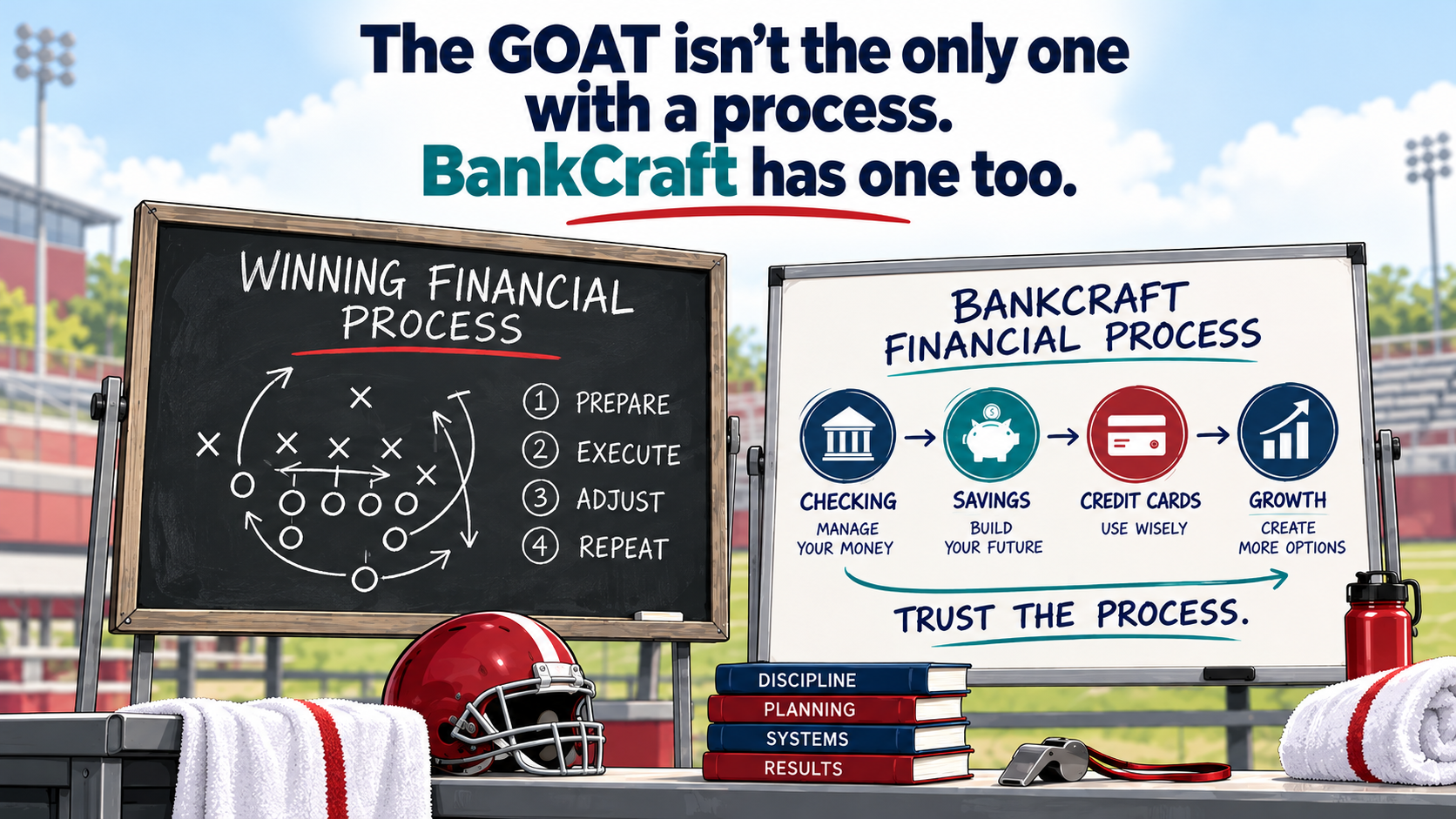
Discover how assigning jobs to accounts and cards, testing payment routes, automating where practical, protecting access to funds, and preparing backups work together. No single protocol solves everything—and no system stays finished forever. The playing field changes. We adapt.
Improvise. Adapt. Overcome. TRUST THE PROCESS!
Read the Featured Case Study →What do you need help with?
Catnip & Shiny Objects
APYs, rewards, qualification requirements, and offers that look better than they really are.
Learn how qualification hoops can change what you actually earn, how missing a few months can wreck a supposedly great APY, and how to compare the offer you can realistically earn with the boring alternative that may actually pay you more.
Read the Lesson →Beware the Elevator Drop Rate™
Savings APYs, balance caps, and rates that drop when your balance gets too high.
Learn how an attractive headline APY can collapse above a balance limit, how to find the rate paid on your next dollar, and why excess savings should get off before the elevator reaches 0.01%.
Read the Lesson →Meet the Institution
Evaluating a new bank or credit union before giving it a bigger job.
Getting approved is only the beginning. Look around, learn how the institution works, decide how much money you are comfortable putting in play, and evaluate check deposits, cash access, ATM networks, fees, and the strengths and weaknesses that determine what job this institution can perform in your banking system.
Read the Lesson →Who Actually Has Your Money—and Is It Insured?
FDIC and NCUA insurance, partner banks, and finding out who actually holds your money.
Find the bank or credit union behind a digital product, verify FDIC or NCUA coverage, and learn why two different front doors may lead to the same insured vault—and the same $250,000 limit.
Read the Lesson →Try Before You Buy
Testing a new bank or credit union before moving direct deposit, bills, or major balances.
You don’t have to divorce your bank to improve your banking relationship. Date a new institution before marrying your direct deposit to it: test the app, transfers, and bill payments with a comfortable amount, track what moves, then decide whether the old account keeps a job or retires.
Read the Lesson →When the Bank Says No
Account denials, risk reviews, freezes, closures, and what to do next.
Learn what checking-account reports may contain, why applying from abroad can complicate identity verification, what an adverse-action notice tells you, and how to respond when an institution denies an application or puts the brakes on an account.
Read the Lesson →Making the Connection
Plaid, micro-deposits, and how financial institutions link together.
Learn why “uses Plaid” and “can be found in Plaid” are not the same thing, how one-way and two-way connections differ, why traditional micro-deposits still matter, and why the easiest linking method is not always the most flexible.
Read the Lesson →Can Your Money Get In—and Back Out?
ACH transfers, account linking, push versus pull, transfer limits, and holds.
Understand account linking, ACH transfers, push versus pull, transfer limits, and holds. Learn why a posted balance is not always available money, why bill payments need their own test, and how to document a route before relying on it.
Read the Lesson →The ACH Red Zone
Pending ACH transfers, available balances, and avoiding duplicate commitments.
Learn why scheduled and pending transfers may be hidden from the account ledger, why “available” does not always mean uncommitted, and how a two-pass verification and personal transfer record can prevent duplicate transfers, returns, and fees.
Read the Lesson →Building Bridges
Connecting banks that cannot transfer directly by using a Bridge.
See how a useful bridge can connect two parts of your banking system. Follow the EleVault example, explore alternate routes, and learn what to check when your money has to make two trips instead of one.
Read the Lesson →Cash In/Out and ATMs
Getting physical cash into and out of digital banks and credit unions.
Learn how deposit-taking ATMs, Shared Branches, local institutions, retail cash deposits, money orders, ATM-fee reimbursements, and Bridge accounts can give physical cash a reliable route into and out of your digital banking ecosystem.
Read the Lesson →The Elephant in the Room: Routing or Structuring?
Legitimate transfer routing, transfer limits, and how that differs from structuring.
Learn why documented ACH routing through legitimate Bridges is not automatically structuring, how transfer limits work, what questions to ask if an institution raises the issue, and how to explain the complete route without hiding the money.
Read the Lesson →Cash Back Is an Instrument, Not a Perk
Credit-card cash back, reward percentages, caps, fees, and specialist cards.
Use the Gas Pump Test to compare percentages with cents-off offers. Learn how an everyday card and a few specialists can work together, how caps and fees affect the result, and why paying the full statement balance matters.
Read the Lesson →Tap to Pay: Trendy Toy or Security Upgrade?
Tap-to-pay, digital wallets, tokenization, and safer card use.
See how Samsung Wallet, Google Wallet, and Apple Pay replace the physical card number with a payment token. Learn why carrying less plastic reduces your exposure, why the amount still needs checking before you tap, and how easy spending can become almost too easy.
Read the Lesson →The Flashlight, Not the Wrench
Using AI to understand banking questions without letting AI make the decision.
Learn how to use AI as a second set of eyes when banking gets confusing: point it at the actual problem, sanitize what you reasonably can, compare answers when useful, and verify anything important with the institution or official source. AI can illuminate the work. It does not make the decision for you.
Read the Lesson →Access Is Part of the Account
Banking while traveling, blocked access, VPN issues, verification codes, and backup access.
Explore the access problems that can appear when you travel: blocked websites, VPN restrictions, and verification codes you cannot receive. Learn what to check before leaving and how another institution can provide a dependable backup.
Read the Lesson →