
BankCraft Classroom
Beware the Elevator Drop Rate™
The high-yield account that welcomes your money on the top floor, then pulls the floor out from under your next dollar.
Examples reviewed September 5, 2026
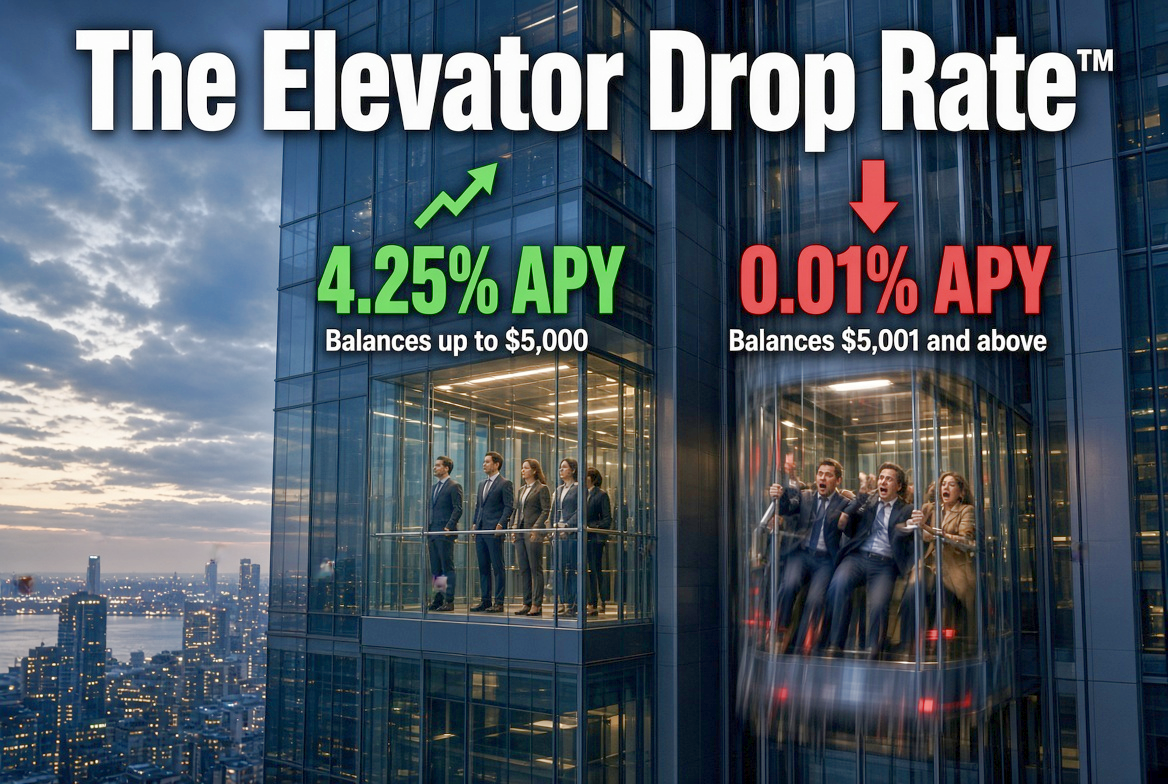
Everybody feels good on the top floor.
People fear elevators dropping even though modern elevators have layers of safety systems. The image remains because we have seen it in the movies: the floor disappears, the car plunges, and everybody drops toward the basement.
Some financial institutions have recreated that experience for your money.
They invite you aboard with an attractive headline, 4.40%, 5.00%, sometimes more. You step in, the doors close, and everything feels wonderful. Then your balance reaches the advertised limit. The institution pulls the floor out from under every additional dollar and lets it fall.
BankCraft Term
What is an Elevator Drop Rate?
In a marginal tier, the first portion keeps its higher rate and only the excess dollars fall. The headline rate is real. The trap is assuming that the words high-yield savings still describe every dollar after the limit.
At 0.01% APY, an extra $500 earns about five cents in a year. An extra $5,000 earns about fifty cents.
Not every step-down is an Elevator Drop.
Ordinary Step-Down
The next tier declines but still pays a meaningful rate. It may disappoint, but the money is still working.
Elevator Drop
The excess portion falls from a competitive rate to a token rate, often the basement-level 0.01%.
Qualification Trapdoor
Miss a monthly requirement and some or all of the account may drop to 0.01%.
A whole-balance trapdoor is more dangerous still: crossing a threshold or missing a requirement reduces the rate on every dollar, not merely the excess. Determine which mechanism the disclosure describes.
Illustrative Rate Structures
How the Elevator Drop appears in real disclosures.
These anonymized examples reflect rate structures observed in official institution disclosures reviewed on September 5, 2026. Institution and product names are omitted because rates, terms, and account structures can change. The purpose is to recognize the pattern, not preserve a permanent judgment about a particular institution. Always check the current disclosure before opening or funding an account.
| Institution and account | Top floor | What happens next | Structure |
|---|---|---|---|
|
Financial Institution 1 Unnamed savings account |
4.40% APY on the premium portion, advertised as up to $5,000 | The portion above $5,000 earns the lowest listed rate: 0.01% | Excess-balance Elevator Drop |
|
Financial Institution 2 Unnamed youth savings account |
5.00% APY through $5,000 | Balances over $5,000 earn the institution’s regular savings rate, listed at 0.01% when reviewed | Excess-balance Elevator Drop |
|
Financial Institution 3 Unnamed high-yield checking account |
4.75% APY through $10,000 when monthly requirements are met | Balances over $10,000 earn 0.01%; missing requirements also produces 0.01% | Elevator Drop plus qualification trapdoor |
|
Financial Institution 4 Unnamed savings account with linked requirements |
5.00% APY through $25,000 when linked conditions are satisfied | Above $25,000.01, the disclosure showed a blended 0.01%–5.00% when reviewed; missing linked-account criteria produced 0.01% | Elevator Drop with linked qualifications |
Why a range appears: a blended APY combines the premium tier with the basement tier. It is not the rate paid on the next dollar.
The arithmetic they hope you never perform.
Here is what excess money earns at 0.01%, compared with the same amount at 4.40%. This illustrates opportunity cost; it is not a promise that another available account will always pay 4.40%.
| Excess in the basement | At 0.01% | At 4.40% | Difference per year |
|---|---|---|---|
| $500 | $0.05 | $22.00 | $21.95 |
| $5,000 | $0.50 | $220.00 | $219.50 |
| $10,000 | $1.00 | $440.00 | $439.00 |
| $25,000 | $2.50 | $1,100.00 | $1,097.50 |
Should an institution treat a customer, or a member-owner, this way?
A bank calls you a customer. A credit union calls you a member and an owner. The legal relationships are different, but the practical question is the same: should either institution invite your money with an attractive headline rate and then pay practically nothing on every dollar above the premium limit?
A balance cap may control funding costs or spread a premium benefit among more customers or members. A reasonable step-down can accomplish that. Neither the bank-customer relationship nor the credit-union member-owner relationship requires dropping the next dollar to practically nothing.
Read the next-dollar rate.
A table may show a range because it displays the blended APY across several tiers. That range does not tell you what the first dollar above the threshold earns.
- What does the first dollar above the advertised limit earn?
- Does the lower rate affect only the excess or the whole balance?
- What happens if you miss a monthly requirement?
- Is the displayed number a tier rate or a blended APY?
- Where can the excess money perform a better job?
An account with a sharp cap can still be useful. Give it the job it performs well, stop at the profitable floor, and do not feed a one-trick pony money it was never built to carry.
Help Document the Pattern
Found another Elevator Drop?
Send the institution name, account name, headline APY, balance limit, rate above the limit, and a link or screenshot of the official disclosure.
Reader reports are leads, not proof. Bank on My Terms verifies the current rate page, schedule, or account disclosure before using a report. Published instructional examples may be anonymized because the institution’s rates and terms can change.
Send a Field Report →BankCraft Protocol
Do not ride past your floor.
- Write down the headline rate and exact balance limit.
- Find the rate paid on the next dollar.
- Confirm marginal tiers, whole-balance tiers, and monthly qualifications.
- Calculate the return at the balance you expect to keep.
- Set an alert below the premium ceiling.
- Move excess money somewhere it still has a job.
- Recheck the official disclosure regularly.
Remember:
The institution advertises the top floor. You are responsible for finding the basement.
Bank on My Terms, presented by Digital Banking Nomad, provides independent educational information based on real-world experience. Rates, balance tiers, qualifications, and availability can change without notice. Verify current terms directly with the institution before moving money. This is not individualized financial advice.