
The Art of BankCraft™
BankCraft Classroom
Cash In/Out and ATMs
What do you do about cash when using digital banks and credit unions? Sometimes you have cash. Sometimes you need cash. Your ecosystem needs a route for both.
What the Cash?
Digital banking works great until actual paper money enters the picture.
Maybe cash is almost never an issue for you.
Until it is.
Someone pays you in cash. You have emergency cash at home that suddenly needs to reach an account. You need a few hundred dollars while traveling. Or you discover that the digital institution holding your money has no branch anywhere near you.
Checks are usually easier. Many digital institutions let you photograph an eligible check and deposit it through their app.
Cash cannot be photographed into your account.
It is a reason to know your cash route before you need it.
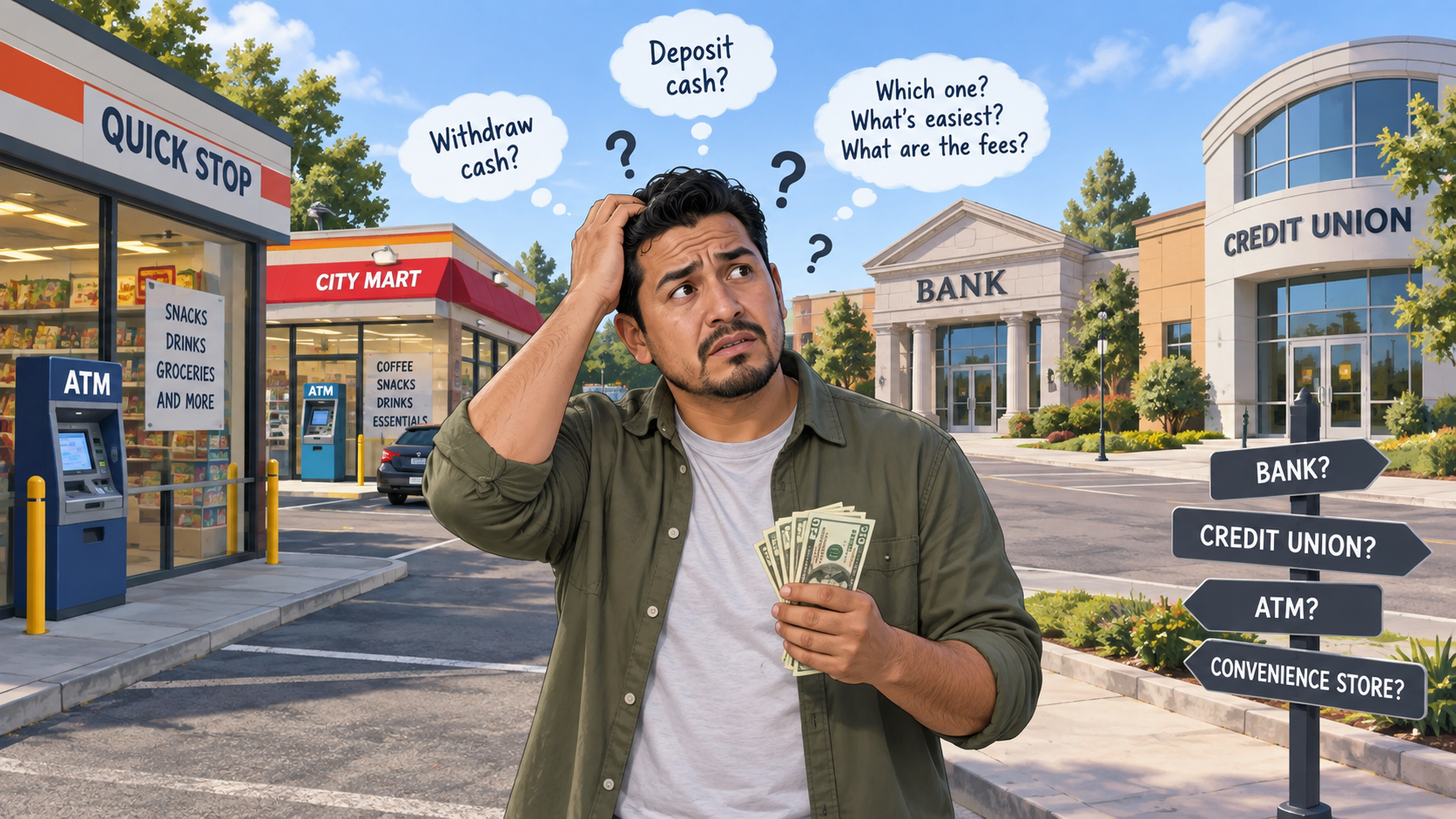
Cash In
You may have more than one doorway.
A digital institution may be exactly where you want the money to end up without giving you a convenient place to hand somebody cash.
That does not mean you are stuck.
Deposit-taking ATM
Some digital banks and credit unions participate in ATM networks that include machines capable of accepting cash deposits. The important word is deposit-taking. Not every ATM in the network will accept deposits.
Local bank or credit union
Deposit the cash locally, wait until it is available, then move it electronically through ACH to the institution where you actually want it.
Retail cash deposit
Some digital institutions allow cash to be added through participating retail locations. The retailer, network, limits, and fees depend on the institution.
Money order
Cash can sometimes be converted into a money order and then deposited if your financial institution accepts that type of item through mobile or another deposit method.
More than one route is the point.
BankCraft is about knowing your options before one route becomes unavailable.
The Local Doorway
A local institution can solve a problem without holding most of your money.
Your local bank or credit union may not have the highest savings rate or the best digital tools.
It may still be extremely useful because you can walk through the door with cash.
If the local institution connects directly to your destination, great.
If it does not, use a tested Bridge.
It does not need to hold much money, and it does not need to connect to everything. It needs a reliable route into the rest of your ecosystem.
Do Not Forget The Money Order
You can sometimes turn cash into something your app can deposit.
A money order is a prepaid paper payment instrument. You purchase it with cash or another accepted payment method and make it payable to a person or business.
For BankCraft purposes, the useful possibility is making the money order payable to yourself and depositing it into an account that accepts money orders.
Money orders are widely available. Examples include:
- Publix sells Western Union money orders at Customer Service.
- Walmart sells money orders through its MoneyCenter or Customer Service desk.
- U.S. Post Offices sell USPS money orders.
- Other supermarkets, pharmacies, convenience stores, check-cashing locations, and money-service businesses may also sell them.
Verify before buying the money order. A money order looks similar to a check, but that does not mean your financial institution will accept it through mobile deposit. Some do. Some do not. Others may require a branch, ATM, mail deposit, a different endorsement, or place a longer hold on the funds.
A cashier's check is different. A cashier's check is generally issued by a bank or credit union using guaranteed funds. A money order is usually a smaller prepaid instrument that can be purchased at many retail locations.
That does not mean your institution will accept it as a mobile deposit.
Cash Out
Getting money out has its own set of questions.
Most digital institutions give you some form of ATM access, but ATM access is not all the same.
- How large is the institution's surcharge-free ATM network?
- Does your institution charge its own ATM fee?
- Does the ATM owner charge a fee?
- Does your account reimburse outside ATM fees?
- Is the reimbursement limited each month?
- What is your daily withdrawal limit?
- Could you move the money to another institution with easier cash access?
Sometimes the easiest cash-out route is simply the ATM.
Sometimes it is moving the money electronically to the local institution that already serves as your physical doorway.
The ATM Logo Is Not Enough
Withdrawal access and deposit access are different capabilities.
An institution may advertise access to tens of thousands of ATMs.
That does not mean tens of thousands of those machines will take your cash.
Can your card use it?
A network relationship may allow withdrawals, balance inquiries, or other card transactions.
Can that machine take money?
Look specifically for a deposit-taking ATM in the institution's current locator.
Can you use another credit union?
Shared Branching is separate from ATM-network participation. One does not automatically guarantee the other.
Who pays the surcharge?
Some accounts reimburse ATM-owner fees. Others do not. Some cap the amount or require a particular account type.
Never assume the network logo means you can make a cash deposit. Verify the specific ATM and the specific service you need.
Real-World Examples
Cash access can look very different from one digital institution to another.
The examples below are based on real banks and credit unions and information published on their websites as of September 12, 2026.
We removed the institution names because the names are not important to the lesson. The useful part is seeing the actual range of ATM access, cash-deposit options, shared services, and ATM-fee reimbursement policies that exist in the real world.
| Example | ATM / Network Access | Getting Cash In | ATM Fee Help |
|---|---|---|---|
| Digital Credit Union 1 | CO-OP ATM and Shared Branch network with more than 30,000 surcharge-free ATMs. | Cash deposits available at participating shared ATMs and eligible Shared Branch locations. | Up to 4 ATM fees per month may be reimbursed. Reimbursement must be requested under the institution's current rules. |
| Digital Credit Union 2 | More than 80,000 fee-free ATMs. | Cash deposits available at select deposit-taking ATMs. Not every ATM in the network accepts deposits. | Up to $20 per month in eligible ATM-fee reimbursement. |
| Digital Credit Union 3 | More than 70,000 surcharge-free ATMs plus access to a Shared Branch network. | Deposit options depend on the account and participating location. Shared Branch access may provide another physical banking route. | ATM-fee benefits depend on the account. Some qualifying checking products offer unlimited domestic ATM-fee refunds. |
| Digital Credit Union 4 | More than 37,000 surcharge-free ATMs. | Cash deposits available at participating CO-OP deposit-taking ATMs. | No broad ATM-fee reimbursement amount was identified for this example. Check the current account terms. |
| Digital Bank 1 | Approximately 91,000+ fee-free ATM locations were advertised when this snapshot was researched. | Cash deposits available at participating ATMs. Cash can also be added through participating retail locations. Retail cash-deposit fees may be as much as $4.95. | Certain checking accounts offer unlimited domestic ATM-fee reimbursement. |
| Digital Bank 2 | ATM withdrawal access through supported networks. Published daily ATM withdrawal limit: $500. | No direct cash deposits accepted. Cash has to enter the banking ecosystem somewhere else and then be moved electronically. | No general ATM-fee reimbursement program was identified. ATM-owner or network fees may apply. |
The names are not the lesson.
One digital institution may give you thousands of deposit-capable ATMs,
another may reimburse $20 a month, another may reimburse ATM fees without
a monthly cap on certain accounts, and another may not accept cash at all.
That is the landscape you need to understand.
Build It Before You Need It
Do not discover your cash route during an emergency.
You do not need to use these routes every week.
You need to know they work when the day comes that you need them.
- Know where you can deposit physical cash.
- Know where you can withdraw cash without unnecessary fees.
- Know whether your ATM network includes deposit-taking machines.
- Know whether a local institution can serve as your cash doorway.
- Know the Bridge route if the local institution cannot reach your destination directly.
- Know whether your digital institution accepts money orders or other paper instruments for deposit.
- Test important routes with a small amount before depending on them.
The day it becomes an issue is not the day you want to start figuring this out.
The Modern Banking Landscape
Different institutions can have different jobs.
One institution may give you local cash access.
Another may hold your savings.
Another may reimburse ATM fees.
Another may exist primarily because it connects reliably to the others.
That is not necessarily a problem.
It is an ecosystem.
You are building a group of institutions whose strengths cover one another's limitations.
Frequently Asked Questions
Cash In/Out and ATM FAQ
How do I get cash into a digital bank or credit union?
Depending on the institution, options may include a deposit-taking ATM, participating retail cash-deposit location, a local bank or credit union followed by an ACH transfer, or possibly converting the cash to an accepted money order or other depositable instrument.
Can I mobile-deposit a money order?
Maybe. Policies vary significantly. Verify that your institution accepts money orders through mobile deposit before buying one.
If my card works at an ATM, can I deposit cash there?
Not necessarily. ATM-network participation and deposit capability are separate. Use the institution's current ATM locator and specifically look for deposit-taking machines.
Why keep a local bank or credit union if most of my banking is digital?
It can provide a physical doorway for cash deposits and withdrawals. The local institution does not have to hold much money. It only needs a useful role and a reliable route into the rest of your ecosystem.
What if my local institution cannot connect directly to my digital account?
Use a tested Bridge institution that can connect to both sides. Your local account does not have to reach every institution directly.
BankCraft Protocol
Cash In/Out and ATMs
Know your cash doorway. Know where physical cash can enter and leave your ecosystem.
Do not trust the ATM logo alone. Verify that the specific machine supports the transaction you need.
Remember the money order. It may provide another route from cash to a depositable instrument, but verify that your institution accepts it before buying one.
Give your local institution a job. It does not have to hold most of your money. It can simply be the doorway.
Use a Bridge when the direct route fails. Your local institution only needs a reliable connection into the rest of your ecosystem.
Test before you need it. Learn the route, limits, fees, holds, and availability while nothing is urgent.
Write the route. Read the route. Say the route.
Bank on My Terms provides independent educational information based on real-world experience. ATM networks, cash-deposit capabilities, Shared Branch participation, money-order acceptance, mobile-deposit eligibility, transaction limits, retailer services, fees, reimbursements, and funds-availability policies vary by institution and can change. Verify current information directly with the financial institution before relying on it or moving money. This is not individualized financial advice.