
The Art of BankCraft™
BankCraft Classroom
Who Actually Has Your Money—and Is It Insured?
Different names on the apps do not always mean different institutions behind the money.
Last reviewed: September 5, 2026

The app is the front door. Find the vault.
A digital banking product can look and behave like an institution of its own. It may have its own name, website, application, debit card, rate, and customer-service team. That still does not tell you who legally holds the deposit.
Sometimes the digital name is a direct product of an insured bank or credit union. Sometimes it is a nonbank company placing customer funds at one or more insured banks. Sometimes the product is not a federally insured deposit at all.
If the institution holding the deposit is not insured by the Federal Deposit Insurance Corporation or the National Credit Union Administration—and the product does not qualify for pass-through coverage through an insured institution—buyer beware. A beautiful application does not replace federal deposit or share insurance.
The $250,000 rule needs the whole sentence.
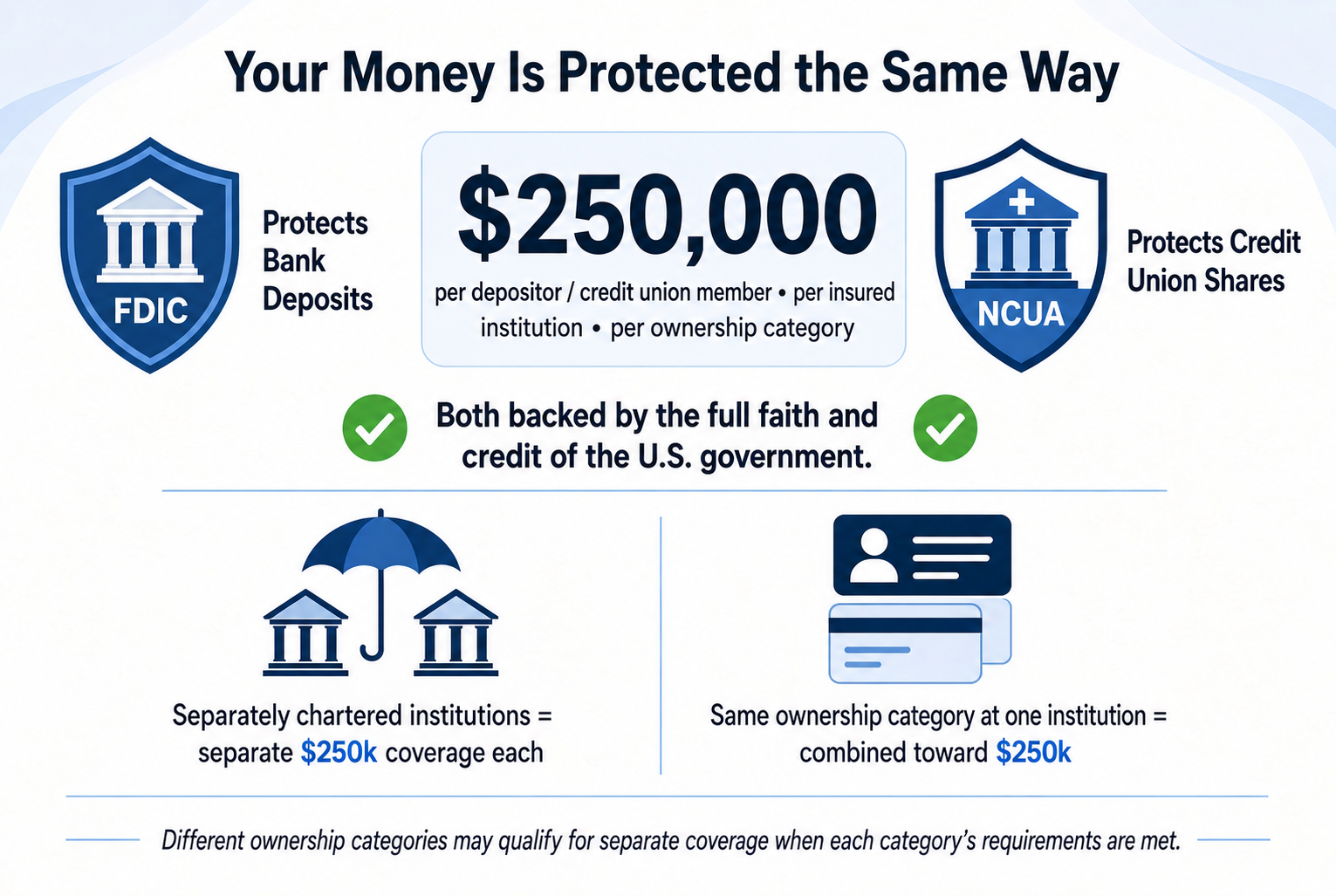
The basic FDIC limit is $250,000 per depositor, per insured bank, per ownership category. Federally insured credit unions use a similar structure through the NCUA’s National Credit Union Share Insurance Fund.
Per depositor
Coverage belongs to the owner or owners of the deposit—not to each account number.
Per insured institution
Accounts at the same bank or credit union are not separated merely because they use different product names.
Per ownership category
Single, joint, certain retirement, and qualifying trust accounts may receive separate coverage when the rules are met.
Five savings accounts in your name at one bank are not five separate $250,000 insurance limits.
The FDIC adds together all deposits held by the same depositor at the same insured bank in the same ownership category, regardless of whether they are checking accounts, savings accounts, money market deposit accounts, or certificates of deposit. NCUA coverage likewise depends upon the member, the federally insured credit union, and the ownership category.
Two names can still lead to one vault.
This is not a theoretical warning. Two products already used in the BankCraft ecosystem demonstrate it clearly.
EleVault and Southern Bancorp
EleVault → Southern Bancorp
EleVault is a direct digital product of Southern Bancorp, Member FDIC. Deposits held through EleVault and other Southern Bancorp deposits in the same ownership category must be considered together when measuring FDIC coverage.
Southern Bancorp may also be the name that appears in the ACH record. If you only know the EleVault name, the transaction can look like it came from an institution you do not recognize.
Relationship verified: September 5, 2026, through public disclosures and observed ACH records.
ValorFI Heroes and Gesa Credit Union
ValorFI Heroes → Gesa Credit Union
ValorFI Heroes deposits are held at Gesa Credit Union. ValorFI’s own disclosure says combined ValorFI Heroes and Gesa deposits are insured up to a total of $250,000 by the NCUA fund.
Gesa Credit Union may also be the name that appears in the ACH record. Someone looking for ValorFI Heroes can be left wondering who this unfamiliar institution is.
Relationship verified: September 5, 2026, through public disclosures and observed ACH records.
A simple hypothetical
$180,000 in individually owned deposits at Gesa Credit Union
+ $100,000 in an individually owned ValorFI Heroes account held at Gesa
= $280,000 at the same credit union in the same ownership category
The two names do not create two limits. Under the basic rule, $250,000 would be insured and $30,000 would exceed that category’s limit.
This only becomes a limit problem when the combined balance crosses the limit.
If you have $2,000 in one product and $8,000 in another product held by the same insured institution, the overlap does not reduce the safety of those deposits. You are still well below $250,000. The lesson is to know the relationship before the number becomes important.
“FDIC insured” may describe the bank—not the technology company.
The FDIC insures deposits at insured banks. It does not insure a nonbank financial application merely because that application works with a bank. When a nonbank company places customer money at an insured bank, the customer may qualify for pass-through deposit insurance if the legal and recordkeeping requirements are satisfied and the funds are actually on deposit at the insured bank.
That distinction matters because FDIC insurance protects against the failure of the insured bank. It does not automatically protect you from the failure, insolvency, bookkeeping errors, or misconduct of the nonbank company standing between you and the bank.
A logo is not the verification.
Read the deposit agreement and disclosures. Identify the legal bank or credit union, then confirm that institution through the FDIC’s BankFind Suite or the NCUA’s Credit Union Locator. If the disclosure only says “funds may be eligible” or uses several program banks, learn exactly when the funds become deposits and where they are allocated.
A brokerage account is another front door.
People holding substantial cash may use Charles Schwab, Fidelity, Edward Jones, or another brokerage instead of leaving every dollar in an ordinary bank account. That does not answer the insurance question. You still have to find where the cash is sitting.
- Bank sweep: Uninvested cash may be swept into deposit accounts at one or more FDIC-insured program banks. Coverage is measured at each participating bank and must include any other deposits you already hold there.
- Money market mutual fund: This is a security, not a bank deposit. It is not FDIC insured, even though it may be designed to maintain liquidity and a stable value.
- Brokerage cash: SIPC protection is different from FDIC or NCUA insurance. It concerns missing cash or securities if a SIPC-member brokerage fails; it does not protect against market losses.
The name at the top of the statement is not enough. Read the line that tells you where the cash is held.
Know what the insurance covers.
FDIC insurance generally covers checking and savings deposits, money market deposit accounts, and certificates of deposit at an FDIC-insured bank. NCUA share insurance generally covers comparable share accounts at a federally insured credit union.
Stocks, bonds, mutual funds, annuities, life-insurance policies, crypto assets, and money market mutual funds are not federally insured deposits merely because they were purchased through a bank, credit union, or brokerage.
You do not need $250,000 for this question to matter.
The aggregation rule may not affect someone whose total at the institution is well below the limit. The first question still matters at every balance: Is this money in a federally insured deposit or share account at all? Losing $5,000 because a product was misunderstood is not made harmless by being below $250,000.
Verify before the money arrives.
- Find the legal name of the bank or credit union in the account agreement or deposit disclosure.
- For a bank, verify the institution in the FDIC BankFind Suite. For a credit union, verify federal share insurance through the NCUA Credit Union Locator.
- Write the underlying institution beside every digital product in your ecosystem.
- Add together balances at the same institution that are held in the same ownership category.
- If your ownership structure is more complicated than one individually owned account, use the FDIC EDIE calculator or NCUA Share Insurance Estimator.
- For fintech or brokerage sweep programs, review the statement or allocation record showing which bank currently holds each portion of the cash.
- Recheck the relationship when a product changes partners, an institution merges, or the deposit agreement changes.
BankCraft Protocol
Verify the Vault
Name the institution. Find the legal bank or credit union holding the deposit. Do not rely on the application name.
Verify the coverage. Confirm FDIC or NCUA insurance through the appropriate government database.
Count by vault. Add balances held at the same institution in the same ownership category—even when the products have different names.
Read the cash position. In a fintech or brokerage account, determine whether the money is a bank deposit, a sweep deposit, a money market fund, or brokerage cash.
Recheck the map. Partnerships, program banks, mergers, and account terms can change. Verify again before a large balance depends upon the old arrangement.
Official references and verification tools
- FDIC: Understanding Deposit Insurance
- FDIC: Deposit Insurance at a Glance
- FDIC: Banking With Third-Party Apps
- FDIC: BankFind Suite
- FDIC: Electronic Deposit Insurance Estimator
- NCUA: Share Insurance Coverage
- NCUA: Credit Union Locator
- NCUA: Share Insurance Estimator
- Southern Bancorp: EleVault deposit relationship
- ValorFI Heroes: Gesa Credit Union deposit disclosure
- Investor.gov: Cash Sweep Programs for Uninvested Cash